Of Pine Cones and Mosquitoes

The women on their daily walk switch from Chinese to English when I stop to chat. One day the topic was pine cones as one woman was carrying home one of the large cones that fall to the ground. They quoted another Asian neighbor: “She says if you put pine cones by your door, you won’t get mosquitoes in your house.”pine cones

Hmm, I thought, something to do with the cones that fall into our yard from our neighbor’s tree. Better than leaving them on the ground to be chewed on by the dog. And mosquitoes are becoming more of a problem in Los Angeles, especially with the appearance of species that can transmit deadly diseases like yellow fever and dengue. The Department of Health asserts that, while the mosquitoes themselves are here, the viruses are not. So far. West Nile Virus is here however.

If you grew up as I did in New Jersey, mosquitoes are part of your childhood memories: that high-pitched whine in your ear when you were trying to sleep on a sticky-hot summer night, mosquito bites that you scratched and scratched until they bled, slathering on bug repellent every time you ventured out-of-doors. Before much of the swampy areas of The Meadowlands was filled in to provide land for stadiums and outlet centers, and communities began instituting heavy-duty spraying programs, people used to joke that the mosquito really ought to be designated the state bird.

Once, a group of friends was planning a visit to a person’s home in Toms River, a community on an inlet of the Jersey Shore. In those pre-cell phone days, the home’s residents instructed us to stop at a nearby gas station to call from the pay phone and alert them to our arrival. They waited by the front door when we pulled up to the house. We jumped from the car and ran as fast as we could to the door which was opened just enough to let us in. I seem to recall there were still some mosquitoes that made it inside.

Mosquitoes didn’t always like human blood, according to an article in The New York Times. Referring to a research study first described in Nature, they used to prefer furry animals to humans. Their switch to humans is “an evolutionary adaptation,” which researchers believe is connected to an “odor receptor gene.” Apparently, we smell better. But because this evolutionary development has gone on for eons, I suppose it’s too late to try to reverse it by just giving up the use of deodorant, body lotion and perfumes. Perhaps we should switch to pine oil.

The Last Time I Was in Ouagadougou…

Well actually, it was the only time. But how many times in my life will I get the chance to say those words? Between Ouaga as it’s called for short and Bobo-Dioulasso, I was in the country of Burkina Faso a total of 14 days. You can read about why by hopping over to my book, African Tales. This blog post is a shameless attempt to get you to do just that.

I bring up Ouagadougou because it’s in the news today. The New York Times has a piece about “tens of thousands” marching through Burkina Faso’s capital city yesterday demonstrating against a proposed change to the West African country’s constitution that would allow President Blaise Compaoré to run again next year. He’s already been in power 27 years, and the people are saying “enough is enough.” Some people threw rocks. The police fired tear gas. See how similar all our countries are?

Our own country went through a similar controversy over presidential term limits back in 1944 when Franklin Delano Roosevelt was elected to a fourth term. Afterward, our country also said “enough is enough” and in 1951 passed the 22nd Amendment barring a president from serving more than two full terms. I was alive then but not paying attention to such things. These days, both the country and the president seem grateful to have the four or eight years come to a conclusion.

Burkina Faso is a usually peaceful place with friendly people who have lived since 1991 under a constitutional democracy “in theory at least,” as one writer put it, “if not always effectively in practice.” The nation, formerly known as Upper Volta, experienced a number of military coups following independence from France, the most recent of which put the current president in power.

Hah! Suspicion Confirmed

A whole raft of scientific studies has concluded that women are better than men at making decisions—especially at times of stress.

Writing in The New York Times, Therese Huston, a cognitive psychologist at Seattle University who is working on a book about women and decision making, says there is evidence that women bring unique strengths to making decisions in pressure-filled situations.

She cites work by neuroscientists in this country and around the world that showed that “under normal circumstances, when everything is low-key and manageable, men and women make decisions about risk in similar ways…But add stress to the situation…and men and women begin to part ways.”

Huston writes that men tend to take more risks when under pressure because they “experience a larger spike in cortisol.” But a slight increase in cortisol seems to improve decision-making among women.

Experiments by other researchers showed that under stressful conditions, women “found it easier than usual to empathize and to take the other person’s perspective. Just the opposite happened for the stressed men — they became more egocentric.”

Huston then wondered whether these findings hold true in the real world. She cites a report by Credit Suisse which after examining almost 2,400 global corporations from 2005 to 2011 – the years preceding and following the financial crisis – found that companies with at least one woman on their boards out-performed comparable companies with all-male boards.

It is unfortunate, Huston writes, “that women are often asked to lead only during periods of intense stress. It’s a phenomenon called the glass cliff in which highly qualified women are asked to lead organizations only in times of crisis.”

Huston concluded, “If more women were key decision makers, perhaps organizations could respond effectively to small stresses, rather than letting them escalate into huge ones.”

You might want to think about all this when filling out your ballot in the mid-term election – and please, please be sure to vote on November 4 – and consider choosing good women candidates (the sane ones) over men. Perhaps if our Congress had more women members, there would have been less gridlock, and more work of substance accomplished in the past six years of President Obama’s term. New York Senator Kirsten Gillibrand recently made a similar point, saying women are more focused on finding common ground and collaborating. Wouldn’t that be a nice change in Washington?

Morning Does Not Become Us

????????????????????????????????????A friend sent this video of a Great Dane puppy reluctant to rise up from the comfort of his owners’ bed. She said it made her think of us because, I assume, that has always been our dog breed of choice. I’m not sure if she also knows that reluctance to wake up in the morning is a trait I share with that puppy.

I’ve written before about our current Great Dane Lotte and how she stays in her bed until I drag myself out of my own bed across the room. As I make my slow way up the stairs to the living room, she similarly hauls herself up behind me, eventually flopping down again on the floor and going back to sleep. It’s something I’d also like to do most mornings but don’t. There are the papers to read and the email to check and, in a while, a dog to be fed and walked. But getting to that point is, for me, hard. One of my daughters told her high school friends, “My mother gets up at 5, but she wakes up at 10.”

A few years back, at a sorority reunion – older women trying to relive their college years – I came down the steps the first morning to the cacophony of many women’s voices, bright and chipper-sounding and made my way in silence to the coffee machine. I found a corner to sit, just me and my coffee cup, but a woman came up and tried to start a conversation. I grunted. Another woman, my roommate when we lived in this sorority house, told my interlocutor, “Don’t try to talk to her until she’s had her coffee.” My roommate from long ago remembered! I was touched.

In the early days of our marriage, and indeed for many years, Ed would bring me coffee in bed, a lovely perk of marriage, I thought. He’d bring his own coffee and the papers and we’d sit in bed drinking coffee and reading the papers, even on work mornings. I wonder what became of that practice and when it ended. Perhaps when we bought reading chairs and designated part of the living room “the library.”

Medical experts are now saying that teenagers need to sleep longer in the morning and some schools are trying to accommodate by starting classes later. That leads me to think, once again, I was born in the wrong time. Or else, disturbing thought, that I’ve never actually grown up.

https://www.youtube.com/watch?v=71smG5d29to

[Photo: “Shameless,” pewter sculpture by Louise Peterson

Africa On My Mind

The world lurches from one crisis to another. The media struggles to continue keeping us informed. And in the process, ongoing coverage of particular news stories drops from view. In my case, it’s been news about Mali and especially Timbuktu, so that is why The Guardian’s photo essay by Sean Smith and accompanying stories by Alex Duval Smith was such a welcome addition to my inbox.

When they say that travel broadens a person, I guess it means that it expands your interest and understanding of a place and its people. If you were lucky enough to actually meet people in another country, as opposed to just glimpsing them from the window of a tour bus, the experience stays with you forever. And even if you didn’t maintain contact with those people, your concern for them and hope for their well-being remains.

When rebel jihadists invaded Mali’s northern desert region and fundamentalist Islamists announced their intention to impose Sharia law, one of my first thoughts was for the cute and giggly teenage girls who walked along Timbuktu’s dusty main street with my cousin and me. What would become of them and other women and girls we met? The fact that the militants have been routed and peace somewhat restored is only partly comforting because you know it could happen all over again when the French and United Nations troops depart.

When I read about militants seizing and destroying ancient documents I thought of the earnest young man at the Ahmed Baba Center for Historical Research who described the library’s efforts to preserve brittle manuscripts written in various languages and convert their contents to digital and other formats. They were hoping to obtain a university internship in the west for an African student to learn about modern preservation techniques. How horrible it must have been for scholars to see those precious materials, to which they’d devoted their lives, being carried off. But then I read later how not just librarians but ordinary citizens of Timbuktu took it upon themselves to hide documents, even burying some in the ground during the uprising, to save them. Stories like that came afterward and were inspiring, as are The Guardian’s depictions of a people persevering against unimaginable challenges.

Returning from five weeks in three west African countries and later, from three weeks in southern Africa, I wrote stories about my experiences because that’s what writers do. But, much as it would have pleased me to see these stories in a published book, I did not feel I had the right to do so. I was not presented as a writer to the people I met and photographed. I was just “Dorothy’s cousin” who was along for the experiences. So I’m putting the stories here on this website of unpublished material, having started with Timbuktu, with more to follow. I hope you enjoy reading them and find the experience “broadening.”

Ditch the White Shoes

I don’t care what they say: Wearing white shoes after Labor Day just feels wrong.white-women-shoes-1368206012jxt

TIME marked Labor Day yesterday with a video on their website purporting to explain why it’s now okay to wear white after Labor Day. The reason, apparently, is because fashion editors say so. Using photos from the magazine’s archives, Diane Tsai showed how the no-white-after-Labor-Day tradition began primarily among well-to-do East Coasters returning to the city from their summer homes. The fact that East Coast summers were frequently followed by cold, rainy autumns contributed to the aversion to lightweight summer clothing. And the shoes just followed along. But it was never a rule, she says, just a tradition.

My West Coast fashionista daughter has always laughed at my adherence to that tradition. “We don’t pay attention to that out here,” she’d say. She’d also laugh when I’d tell her I’d spent the weekend changing over my closet from summer to winter wear. “We don’t do that,” she’d tell me. Now I live in the perpetual summer of Southern California and my closet has winter (such-as-it-is) wear hanging right alongside summer – because you never know when the temperature could change.

But white shoes? They’re relegated to an upper shelf until Memorial Day. For me, some traditions will stick around as long as I do.

[Photo: Shoes by George Hodan]

Backhanded Compliments

US OpenThe U.S. Open is getting underway today in Queens, NY, not far from where my New York daughter and her husband live, and the New York Times Magazine is awash in tennis talk and nostalgia, and so am I. I, the early tennis dropout.

Both my parents were avid tennis players, and my father tried valiantly to turn me into one as well. But I was skinny and pigeon-toed and claimed to be more interested in ballet. Until I became a dropout there as well. That was when I became interested instead in high school and being popular and having boyfriends. My poor father.

What I seem to remember most about tennis instruction from my father in the times we spent at the East Orange (NJ) Tennis Club is how to place your hands on the racket. What is that called? The handle, the arm? You see what a dropout I was: I can’t even remember the terminology. You were supposed to arrange your hand around that part of the racket with your fingers just so if you were going for a forehand shot, and then shift the position just so for a backhand shot. BOR-RR-RING!

And now Michael Steinberger is writing in the Times Magazine about the demise of the one-handed backhand. “The one-hander has become the last redoubt of artistry in tennis,” he writes, “a final vestige of the sport as it was traditionally played.”

I did wonder, in the years after his death, how my father would have reacted to the two-handed backhand being practiced at first by the likes of Jimmy Connors, Chris Evert and Bjorn Borg, and then later by nearly everyone, just as I similarly wondered what he would have said about the relaxation of the tennis whites dress code. And how about the shouting and displays of temper? Fortunately for him, my father died in 1970 and missed all the upheaval the sport endured, not to mention that in modern life in general.

But Ed and I are determined to make it into ripe old age so our children will witness all of our stumbles in geezerhood, embarrassing them and ourselves with our intransigence in the face of so-called progress. It’s so they won’t be surprised when their time comes.

But here’s something I gleaned from Steinberg’s article: “The fact that children’s rackets, like adult rackets, are significantly lighter these days suggests that it should be easier now to teach a 10-year-old to play with a one-handed backhand than it was 20 years ago. In addition, many children are being taught to play tennis using low-compression balls which are more conducive to rallying and perhaps more conducive to hitting backhands with just one hand.”

Squash playerThere you have it: I coulda been a star. Just born in the wrong time.

[Photo: Yes, I know that’s a squash racket, but my father had high hopes that I would become a multi-sports phenom.]

In the Pink? Never!

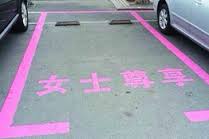
pink parkingA shopping mall in China has been accused of sexism after introducing special pink parking spaces just for women. The spaces at the World Metropolis Center in northeastern Dalian are about 11 inches wider than normal spaces and painted hot pink. Denying that the spaces insult women’s parking ability, mall officials said their larger spaces were designed “for practical purposes,” according to a report in the Shanghai Daily. “It doesn’t mean that women drive less well than men.”

Other cities in China have pink parking spaces, as does Seoul, South Korea, which has 5,000 spaces near the entrances to malls and other buildings. The explanation there is that they are provided as a convenience for women in high heels. The Korean spaces include a mini-skirted female figure as a graphic element. And in Germany, the city of Baden Wurttenberg mandates that at least 10 percent of parking spaces in large garages be for women; in Brandenburg it’s 30 percent. German officials say it’s to make women feel safer and less open to sexual assault.pink  parking 2

I am reminded of an incident soon after we’d moved to Los Angeles when I was rushing alone to church and hurriedly pulled into an unattended garage that is made available on Sunday mornings. As I turned into a space, the sound of a large crash reverberated through the garage and a man walking toward the exit spun his head around but then kept going. I got out of the car to inspect the bumper of the car I’d hit and then straightened my own car and locked up. At the corner, waiting for the traffic light to change, was the man from the garage and a woman I know. “Just so you know,” I told the man, “the other car was undamaged.” And then to the world in general I muttered, “I don’t know, ever since I moved here I have trouble with parking spaces.” “It’s because they are smaller,” the woman said.

If you think about it, parking garages in older cities – or in cities unlike Los Angeles with its old penchant for tearing down structures and building new ones – have spaces that were designed for older, bigger cars. Newer garages were designed with today’s smaller cars in mind. So I’m not a bad parker, just still living in the past, something that seems to come up more and more frequently these days.

Ed is the proud owner of a handicap tag, granted some years ago because of walking difficulties stemming from back problems. He will insist I drive all the way around a parking lot, passing several perfectly good spaces, to get to the handicap-designated one. It was only recently that he told me why. “These spaces are much roomier,” he said, “so there’s less danger of the driver next to you smashing his door into your car.”

Ah, so what we all need are wider parking spaces. Just please, don’t paint them pink.

[Photos: abcnews.go.com; news.kron4.com]


Good for You, Justice Ginsburg!

Sexism even on the Supreme Court? Why am I not surprised?  Justice Ginsburg

In a New York Times article by Adam Liptak, Justice Ruth Bader Ginsburg is shown comparing differences in the court’s rulings on gay rights cases with those involving gender. The gay rights rulings are replete with soaring language about “equal dignity” and endorse values of “liberty and equality,” while those dealing with gender issues seem to indicate that the court has not fully embraced, in her words, “the ability of women to decide for themselves what their destiny will be.” She noted, Liptak writes, that “the court’s five-justice conservative majority, all men, did not understand the challenges women face in achieving authentic equality.”

Those challenges are ones that have dogged the 81-year-old Ginsburg her entire life, from attending Harvard Law School as one of nine women in a class of more than 500 to graduating from Columbia Law School and being denied jobs with law firms or judicial clerkships because she was a woman. As a professor at Rutgers School of Law she was informed her pay would be less than her male colleagues because her husband, also a lawyer, had a good job.

Before becoming a judge, Ginsburg was a prominent women’s rights attorney, and yet, on the Supreme Court, Liptak writes, she “has suggested that her male colleagues sometimes do not hear a woman’s voice, including her own. In a 2009 interview with USA Today, she said the other justices, who were then all men, sometimes ignored the arguments she made at their private conferences.” She would say something but it would not be focused on until someone else said the same thing.

It’s been a lot less lonely for the justice now with the addition of Justices Sonia Sotomayor and Elena Kagan, but their inclusion has not kept the court from delivering devastating setbacks in cases involving equal pay, medical leave, abortion and contraception, culminating, as the Times article points out, “in a furious dissent last month from the court’s three female members.”

Some liberals are urging Justice Ginsburg to retire so President Obama can appoint her replacement before his term ends, thus assuring that a liberal voice will not be lost. But the justice says she has no intention of doing so as long as her health and intellect remain strong. And good for her.  It’s supposed to be a lifetime appointment after all, so quit trying to push her out. Instead, perhaps those people should direct their efforts toward assuring that the one who will be doing the appointing shares the same philosophy. Imagine what a liberal majority could accomplish.

Photo: en.wikipedia.org

The Secret Word Is Banana

I flunked the short-term memory test today at the doctor’s office. “Here are three words: banana, sunrise, chair,” said the nurse. “What are the three words?” “Banana, sunrise, chair,” I repeated proudly. Many questions and unrelated conversations later, she handed me a piece of paper. “Write those three words I gave you earlier,” she said. All I could remember was banana, probably because I’d had nothing to eat, it being lab tests that required fasting. “Hey,” I protested, I thought I no longer needed those words so I sloughed them off. That’s what we old people do.”

Another new wrinkle (no pun intended) in the aging process is that one’s annual physical now includes psychological questioning to determine whether the person is depressed, suicidal, drinking too much, losing sleep and a lot of other things including becoming more forgetful.

For one of today’s tests, the nurse asked me to draw the face of a clock and to indicate the time of 11:10. I was proud of the fact that I started with the 12, 3, 6 and 9 and then filled in the other numbers. Shows I recognize spacial distances, I thought. When I got home I happened to glance at a clock. Oh, my gosh, I’d mixed up the hands, showing the time as 1:55. Sure hope she remembers my mentioning I am left-handed. We left-handers frequently get things backwards.

I don’t mean to make light of these kinds of tests. We are all terrified of developing dementia or Alzheimers, its most common form, accounting for 60 to 80 percent of cases. According to the Alzheimer’s Association, the disease “is not a normal part of aging, although the greatest known risk factor is increasing age, and the majority of people with Alzheimer’s are 65 and older.” But, the Association’s literature continues, “up to five percent of people with the disease have early onset Alzheimer’s which often appears when someone is in their 40s or 50s.”

So what to do? A person I know gives himself daily mental exercises through luminosity.com. Others play Words with Friends online or do crosswords and word puzzles. My hope lies with two daily newspapers and a bunch of magazines, along with constant book-reading. It is scary to imagine what it must be like to be aware of your mind slowly fading away.

I joked a lot during today’s testing and made the nurse laugh several times. Next time I’ll take it more seriously. The joking older people do about memory loss is akin to whistling past the graveyard. Which is another thing we’re good at.