Gloria Steinem is 80!

gloria steinem

And she’s marking it by going to Botswana to ride elephants.

An article in The New York Times is titled “This Is What 80 Looks Like,” and according to the article’s author Gail Collins, 80 looks every bit as glamorous as every other decade for this feminist icon. Smart, articulate, open, empathetic and yes, glamorous, Gloria Steinem has served as a lodestar for many women of my generation. Sure, there were plenty of others who pushed gender equality along its slow, torturous journey, starting even before 19th century suffragists in England and the United States. But Steinem is special.

Collins calls her “the face of feminism” and writes, “For young women who were hoping to stand up for their rights without being called man-haters, she was evidence that it was possible to be true to your sisters while also being really, really attractive to the opposite sex.” But while men tended to concentrate on Steinem’s appearance, what mattered most to her was what was going on inside her head and others’, which is why, Collins says, this most famous person is approachable and intent on paying attention to the thoughts of those she meets in her travels around the world.

It was not only men who tended to concentrate on women’s external attributes while dismissing the internal. Some years ago I connected with an older woman who had been my boss years earlier. She told me what she had said about me to another editor when recommending me for a job. “I told her she would never be embarrassed about your appearance when sending you out on assignment.” Big whoop, I thought. I’d have preferred if she’d said I was a good writer. Or a fast writer. Or dependable. Or kept my desk neat. But I’m sure she thought I was flattered.

Graduating from college as I did in 1960, I always felt our generation of women sat on the cusp of the women’s movement, ready to fall either back toward the 1950s or ahead toward the future. Some of my contemporaries did tend to emulate their mothers, buying into the ‘50s narrative of women’s place in the home, nurturing the children and serving as the husband’s helpmate. But others were afflicted with this nagging idea that “there has to be more to life than this.”

My friend Margo and I, both young mothers in Sacramento, discovered we were simultaneously reading Betty Freidan’s The Feminine Mystique and exclaiming every few pages, “Yes!” A while ago, one of my daughters borrowed my copy of the book and had great difficulty getting into it; I don’t think she ever finished. She didn’t get it. You had to be there, I suppose.

I was an early subscriber to Ms., the magazine Steinem co-founded and edited for 15 years. But I am chagrined to say that somewhere along the years I let the subscription lapse. So much to read, so little time. However, looking over the accomplishments of this writer, lecturer, editor and feminist activist as enumerated on her official website, I feel like a complete slacker. What have I done with my time? I haven’t even ridden an elephant, though I’m a few (very few) years behind Steinem in age. I did ride a camel, though, out onto the Sahara in Timbuctu. I wonder if that counts for something. Probably not.

Bring on the elephants!

Photo: plannedparenthood.org

Happy St. Patrick’s Day!

St. Patrick's Day Parade (2)

I’ve always been grateful to St. Patrick – and to the nurses at Columbia Presbyterian Hospital in New York City. That’s because I know what name my parents were considering for the newborn me. A pretty name except when uttered in a bad New York/New Jersey accent. But the nurses convinced my parents otherwise. “It’s St. Patrick’s Day! You can’t possibly name her anything but Patricia,” they said. And that’s why a half-Italian, half-Midwestern American Melting Pot baby got named for the patron saint of Ireland.

St. Patrick’s Day is not as big a deal here in Los Angeles as it traditionally has been in New York. Oh, you can find restaurants serving corned beef and cabbage and bars selling green beer. There are parties and public gatherings including one on the Queen Mary but no parade, save for the one in Hermosa Beach 22 miles from downtown. And one LA pub is opening its doors at 6 a.m. so I suppose there will be sightings of inebriated celebrants sporting “Kiss Me, I’m Irish” buttons. New York’s new mayor, Bill De Blasio (whose Italian last name is not the one he started out with) is boycotting the New York parade this year because organized gay and lesbian groups are excluded. Cities across the country mark the occasion with parades but New York’s is the oldest, dating to Revolutionary War times, and the largest with 200,000 participants and three million spectators. The top of the Empire State Building is traditionally bathed in green light. Elsewhere, the Chicago River is dyed green, as is the north White House fountain.

St. Patrick was not actually Irish, although he spent most of his life in Ireland. And he did not rid the country of snakes because Ireland never had snakes to begin with. Also, unlike other holidays that commemorate a famous person’s date of birth, March 17 is the day in 461 that Patrick died. Those and a lot of other fun facts can be found at history.com.

My husband Ed was born on Columbus Day –  the official date, not the floating one established by Congress in 1968 (along with Memorial Day, Veterans Day and President’s Day) to provide more three-day holiday weekends. So I asked his mother one day why she hadn’t named him Christopher. “Why would I do that?” she asked, puzzled. No intervening nurses there, I guess. But it’s probably just as well since Columbus Day has become controversial as some of Columbus’s actions have been learned. It seems he returned to Spain with native people as slaves, and of course we now know his discovery ushered in a shameful period of discrimination and decimation of native people here and in Latin America.

Several communities have replaced Columbus Day with alternative days of remembrance. These include Indigenous People’s Day in Berkeley, as well as South Dakota’s Native American Day and Hawaii’s Discoverer’s Day commemorating the arrival of Polynesian settlers. But Columbus Day is also significant for Italian-Americans in places like New York which still has a Columbus Day parade. Wonder how the mayor with the adopted Italian name will handle that one when the time comes.

Maybe what we need in these dispirited times is more parades – and more three-day weekends.

Photo: history.com

LA Speak

“Are you in, as they say, The Industry?” I asked the man I’d just met, my tone of voice putting imaginary air quotes around the term. It’s what people in the movie business call their place of work, and it always makes me smile. I’m from New Jersey. When I hear “The Industry” I think of smokestacks. Not filmmaking. But after eight years, I’m getting used to it, along with many other terms.

Like “big rig” instead of tractor trailer and “crash” instead of accident, and of course “freeway” instead of highway but that last term may be one that’s headed for oblivion now that toll roads are being introduced. (When I was in high school, I was among Girls and Boys State alumni invited to appear on television with the Governor. “What will I ask him?” I queried my family, desperate to not sound stupid. “Ask him how long the tolls will remain on the Garden State Parkway just now being built.” I did and his answer was one that also makes me smile: “Just until the highway is paid for.” Yeah, right.)

When we first got here, the radio traffic reports kept talking about “sig alerts.” “What do they mean by that?” I asked the California daughter. “It means a traffic accident,” she said, her Jersey roots not completely obliterated. But why sig? Turns out the term honors a long-time LA radio executive, Loyd Sigmon who invented a system for speedily reporting news of traffic problems. His only compensation for the invention was having it named SigAlert, according to snopes.

I acclimated pretty quickly when it came to naming freeways, referring to them as “the Two” and “the Five” rather than Route Two or Route Five. And I do avoid such roadways whenever possible by taking what are called “surface streets,” even though that sounds as if all others are elevated.

Another LA habit I apparently have acquired is to give distances in driving time, preferably using the most optimal times possible. “Every time I ask you how far you are from a place, you say ‘twenty minutes,’” a friend back East said. “That can’t be possible.” Well, no, it’s not. But a lot of places are twenty minutes away, give or take some. (In New Jersey, our home was fourteen miles from Manhattan, which could have easily translated to an hour and a half on some days, so I think there you’d rather say mileage.)

So excluding Surfer Dude and Valley Girl phrases that I never come in contact with (I still don’t know if “gnarly” is a good thing or a bad thing), I am learning to talk LA. Now, if only I didn’t have to pump my own gas. (In New Jersey where it’s still illegal to do so, a certain relative with a conservative bent would fulminate about that situation every time he came to visit. “That’s just the unions making work for people,” he’d say, to which I’d reply, “And that is a bad thing because…???”)

OK, enough car talk. Next thing to consider is why sticks of butter here are shaped shorter than conventional butter dishes call for. But that’s a question for another time.

Didn’t It Rain, Children?

They’d been talking about the coming storms for days. Everyone knew, a small one due one night and then a really big one hitting all weekend long. The supermarket was crowded with people stocking up. A neighbor quickly cleaned out his gutters. And with the first storm came traffic accidents and closed highways. Really, just like the rest of the country. But this is Southern California and the precipitation was not snow but rain. Much needed in a state experiencing an unusually long-running drought.

Before we all had a chance for dancing in the streets, however, the experts warned that no matter how much rain falls in the next few days, it will still not be enough to end the draught. Farmers in the Central Valley will still leave some fields unplanted  ̶  “higher food prices!” your brain telegraphs. Ditto for vineyards  ̶  “oh no, not Buck-Forty-Nine Chuck!” (Trader Joe’s Charles Shaw wine, formerly referred to as “Two Buck Chuck” and elsewhere as “Three Buck Chuck” is now during the Never-Ending Great Recession our house wine.)

Another neighbor just finished having a whole new roof installed and very nicely did not act smug when I asked for the roofer’s name. We’d known our roof needed work but we’d put it off   ̶  “hey, it never rains here.”

I’ve tried to be discreet this winter about the gorgeous 80-degree sunny weather we’ve experienced while the rest of the country had hideous polar vortex repercussions. The New Yorker daughter has sent snow pictures taken from her apartment window and even a video of the flakes gently falling. “But it’s beautiful,” I’d reply when she’d tell of the unrelenting wind and cold. The Los Angeles daughter, in New York for business, also sent a picture of a snowy street accompanied by a rude comment. “Still beautiful, though,” I said.

Ed does not share my nostalgia for snow.  The best part of the house sale back east, he says, was seeing the snow shovel walk out the door.

“Do you miss snow?” a longtime California resident asked me. “I do,” I told him. As long as you can remain inside, get someone to plow the driveway for you and not have to chip away at an ice-encrusted car, it’s really quite lovely to be snowed in. It’s a good time to tackle projects you’ve been avoiding like emptying out a cabinet and cleaning its contents. No snow days is probably why our cabinets here are filled with dusty objects. We’ll see whether a rainy weekend helps.

Color Me Gray. For the Moment

Have you ever stood at the back of a large room – an auditorium, a concert hall, perhaps a church – and surveyed the heads of men and women sitting there together? The men’s hair gray or white, the women’s blond, red, brown, black, streaked or highlighted. What is this? Men with their daughters? Refugees from a Cialis® commercial? When did we women of a certain age begin to feel the need to color our hair? And if we consider ourselves equal partners with our men, why are we not equal in the hair color department?

Of course, here in Southern California, lots of men, especially actors, also color their hair. And now that the Never Ending Great Recession has put so many men (and women) on the job market to vie with much younger competition, I suppose dyed hair could be considered a necessity. Maybe even a tax deductible business expense.

Remember the hair dye scare of the 1970s? Because some experiments with laboratory rats and hair dye indicated that coloring your hair could cause various forms of cancer, there was panic among the vast number of people to whom hair dye was of paramount importance. My memory is that the panic was short-lived, eased by assurances that people wanted to hear and that everyone went back to dying their hair. (I was not a hair dye user at the time and my daughters had not yet entered the hair-color-of-the-week experimentation stage so I was only peripherally interested in the subject.) Now I read that sometime in the mid to late 1970s manufacturers changed some of the chemicals used in hair dyes and while studies continue, most results are inconclusive.

But that is not why I’ve stopped coloring my hair. I’ve found myself admiring women (men too) with wonderful heads of pearl gray or snow white hair. People like poor beleaguered Health and Human Services Secretary Kathleen Sebelius whose battle to bring affordable health insurance to Americans might have turned her hair white if it weren’t already that way. But it’s beautiful. Also Helen Mirren, Jamie Lee Curtis, Judi Dench. And how about Meryl Streep in “The Devil Wears Prada?”

It’s time to be a grownup, I told myself. And besides, what was under all those blond highlights that had somehow morphed over the years into a mostly blond do? Well, it’s gray. Sort of. In places. Nothing like any of those aforementioned women of course. Still, it fascinates me to watch it showing up. One of those interesting developments of the aging process. Like no longer having to shave your legs, a prospect one of my daughters found exhilarating when I told her.

But don’t hold me to the gray hair thing. I could wake up one morning and go screaming off to the hairdresser for help. Unless, that is, I turn into Helen Mirren.

kathleen sebelius

helen mirren

Jamie_Lee_Curtis_crop

judi dench

meryl streep


[Photos: Kathleen Sebelius, abcnews.go.com; Helen Mirren, helenmirren.com;

jamie lee curtis, wikipedia.org; Meryl Streep, fanpop.com Judi Dench, biography.com]

I KNEW it! (or used to)

Those things that some of us call senior moments are not necessarily signs of early dementia. They’re just an indication that we’ve lived so long, our brains are full. If we have trouble remembering a word, it’s because we have to scroll through so very many words we have accumulated through the years till we hit on the right one.

That comforting thought came in a paper from “Topics in Cognitive Science” describing the work of linguistic researchers from the University of Tubingen in Germany and reported by Benedict Cary in yesterday’s New York Times. It’s always been a given in psychology that, starting at about age 25, the brain ages, and these researchers started with the same assumption. But they employed data mining based on theories of information processing, Cary writes, and “used advanced learning models to search enormous databases of words and phrases…Since educated older people generally know more words than younger people, simply by virtue of having been around longer, the experiment simulates what an older brain has to do to retrieve a word. And when the researchers incorporated that difference into the models, the aging ‘deficits’ largely disappeared.”

See? That senior moment was just your brain riffling through the files.

As people who worked our entire lives with words, Ed and I continually use one another as living, breathing thesauruses (thesaurusi?): “What’s that word that means putting one foot in front of the other and moving forward? You know, not running but…” “Walking?” “Yes, that’s it. Thanks.”

I exaggerate but sometimes the elusive word is almost as simple. The same is true with spelling. How can a person who knows how to spell antidisestablishmentarianism now not know how to spell judgment? And thank goodness for Spell Check. When I can’t ask someone else, there’s always the tactic of typing the word as close to accurately as I can and turning myself over to the computer gods for assistance. Or asking my husband.

Our desks are across from one another. “Excuse me, can I interrupt you for a second?” “You just did.” “Oops, sorry. But since I have, what is the word that means…”

Banning the Bag

The ban on plastic grocery bags has been in effect since the first of the year in Los Angeles, one of 90 cities and counties in California to enact such a ban.  Lawmakers have tried unsuccessfully three times to outlaw the bags statewide but now think they’ve reached a compromise that has a chance of passing.

Environmentalists are pleased. Dog owners, at least this one, not so.

Shortly after the new law took effect, I went to Petco to research what nearly everyone indelicately refers to as “poop bags.” The shelves were stripped almost bare but I was able to learn the bags come in rolls or packs, biodegradable or not, even scented if your sensitivities demand it. I returned home and began using up the free bags we’d collected from the supermarket and other stores. Eventually the day came when I had to return to Petco and become a buyer of bags.

Plastic bags are a necessity of life for the owner of any dog but especially a large healthy dog – unless you’re a pig of a person who refuses to pick up after your pet. And I understand the environmental concern for landfills overrun with bags that will remain non-decomposed until the end of time. But instead of a law banning plastic grocery bags, why not a law stipulating bags be biodegradable? According to today’s Los Angeles Times, the proposed legislation suggests a 10-cent charge for “bags made of recycled paper, reusable plastic and compostable materials…In addition, the state would allow businesses to tap $2 million in recycling funds to retool manufacturing plants and retrain workers who make plastic bags.” Why not “retool and retrain” to make the bags biodegradable?

I know biodegradable plastic bags work. When we moved across country several years ago and unpacked, the massive amount of paper and other packing materials overwhelmed the huge trash bins the city provides for weekly pickups. So we began filling large black plastic bags and storing them outside on the deck until there was room in the bins. After a while, the bags began to melt away in the sun. We’d unintentionally purchased biodegradable ones.

The stores I visit have signs at the entrance reading “Don’t forget your bags” which invariably causes me to reel around and return to the car where a supply of reusable bags now resides. But wouldn’t it be nice if once inside the store there was another sign that read “Because we no longer have the expense of supplying plastic bags, we are reducing our prices by X percent.” Or even “paying our employees more.” Whatever. But no. No bags and if you want a paper bag it’s now 10 cents.

There are other ways to deal with problems. In some parts of Africa, plastic bag litter on the terrain is sometimes called “African flowers.” In Burkina Faso we saw people on the streets selling water in small plastic bags knotted at the top. The buyer bites off one corner of the bag to drink the water and yes, probably frequently drops the empty bag to the ground. We met a Belgian man who had observed that situation and decided to start a business. His bags are filled with pure drinking water unlike those of the street sellers and are made of a heavier plastic. And yes, they’re more expensive. But, he told us, the people like them because they keep the empty bags and use them for other things. It’s been several years but I hope his business has continued to flourish.

In a bookstore recently the checkout clerk offered me a plastic bag. I accepted of course because plastic bags have become treasured. But I asked her why her store is exempt from the ban. “Because our bags can be used for other things,” she said. Huh?!  I thought, can’t they all?

Not Exactly Brenda Starr

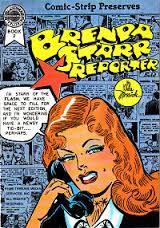
Brenda StarrToday is the third anniversary of Brenda Starr’s final appearance. Oh children, please don’t tell me you don’t know about Brenda Starr.

Brenda Starr was a drop-dead gorgeous newspaper reporter with a magnificent head of flame red hair. She was created in 1940 by Dale Messick, a woman who changed her name to mask her gender, in a comic strip for the Chicago Tribune Syndicate. At the height of her popularity in the 1950s, Brenda Starr, Reporter was carried in 250 newspapers, and even as recently as 2010 the strip was appearing in 65 newspapers, 35 of them international papers. The final strip appeared on Jan. 2, 2011.

Even though we knew Brenda’s story with its glamorous international assignments and romantic interludes was pure fantasy, we young women reporters of the 1950s and ‘60s held a special place in our hearts for her. We joked to one another as we headed out to cover some silly society luncheon, “Yup, me and Brenda Starr.” Brenda Starr was a serious investigative reporter; she never covered society luncheons. Brenda Starr never had a journalism professor refuse to admit her into his class because “girls just get married and it’s a waste of my time to teach them” Brenda Starr was never relegated to a newspaper’s women’s department to write wedding and engagement stories because she “didn’t have the gumption” to cover “hard news.” And when Brenda and her longtime love Basil St. John finally married and had a baby girl they named Starr Twinkle St. John, Brenda’s career as an investigative reporter continued uninterrupted. No one told Brenda she should not work because she had a child.

If all of that reads like the disgruntled musings of a fugitive from the Ice Age of American Journalism, I’m sorry. For many of us who had been encouraged by our parents to go for non-stereotypical careers, encountering male resistance was a shock. Dale Messick herself had problems. While the strip was carried by the Tribune Syndicate, the Chicago Tribune’s editor initially refused to run it because its author was a woman. And if her illustrations showed too much cleavage or a navel, the papers erased them out. So yes, we’ve all come a long way, haven’t we, baby?

One of my daughters is a journalist now. When I was retelling for the 99th time how I blew my interview with The New York Times, that daughter said, “But didn’t you explain all that was going on in your life at the time?” (We were living in a hotel with a 3-year-old child while two giant dogs and a cat were racking up boarding bills back in California because we couldn’t find  someone who’d rent to us. Oh, and my father was hospitalized in New Jersey in an oxygen tent following a massive heart attack. The only reason I was in for an interview is because I was summoned.)  No, I didn’t mention any of that. Prospective employers did not want to hear that you had problems of any kind, especially if they thought you shouldn’t be there anyway. Women had to display an ability to DO IT ALL, and no whining.

Now here’s Katherine Zoepf in The New Yorker writing about taking her two-month-old son with her on assignment to Saudi Arabia. And an obituary for Patricia Ryan who rose from the typing pool at Time Inc. to hold managing editor spots at Life and People magazines. She was the first woman in 27 years to be appointed to a top editorial job at Time Inc.  Many women rose above the prejudice of male colleagues determined to keep journalism as a men-only bastion. They did it through talent and determination and by ignoring the naysayers. Much as Brenda Starr might have done.

Quick, Read This Before It’s Obsolete

Among traditions hurtling into oblivion – if not already there – like sit-down dinner parties and landline telephones is the once-reliable and occasionally awful Christmas letter. I’ve been writing one since 1973. That year, the “n” key on the typewriter broke midway through the writing, forcing me to hand-letter the offending consonant the rest of the way. It was probably a sign that I should have heeded. Instead, I barreled on year upon year, imagining that friends and relatives really cared for an update on our family’s doings. Some of them became enablers, writing on their own cards “Sure looking forward to your Christmas letter” just as I was thinking “Maybe this is the year to abandon this practice.” So I’d throw something together, include copies with the cards and get them into the mail, often late (“Hey, it’s the holiday season, close enough.”).

Last year’s letter began “Still boycotting Facebook…” which was a continuation on a theme from the previous year when I suggested that once a year was more than enough “self-absorbed bloviating” and the reason why I was not participating in the social media phenomenon. “If you were on Facebook I could send you pictures of my grandchildren (and my dog and my cat).” I tell them I know how to open e-mailed pictures. “But if you were on Facebook I could send you lots of pictures.” Ah yes, and perhaps that’s another reason to be a non-participant. “Edit, people,” I want to say as I go through cards and letters. “Pick the best picture of your grandchild – or dog or cat – or two if you can’t bear to choose.” That way, the pictures will be large enough for my aging eyes to discern the subjects, rather than a montage of teeny-tiny representations.

But I’m a grump, and for all I know my annual letter is received by groans: “Oh God, here’s that horrible thing again. When is she ever going to quit?”

I try to be reasonably concise, although those early letters did go on a bit. Perhaps I have learned a little something along the way, but maybe not. I frequently have the need to continue on the reverse side of the page. But that’s okay because it leaves me room to scrawl a personal note to the recipient if there’s time. Usually these things are done at the last minute with the postal service’s admonishing “last date to assure delivery” looming. Yes, I know. If I were doing it online, I could wait till Christmas Eve. When there’s nothing else to do.

I also try to be relatively cheerful, even though sometimes I have to convey sad news as in someone’s death or serious illness but I try to use a light hand, reminding myself that people will be reading the letter in the midst of what should be a happy time.

On the other hand, the older I get the less likely I am to refrain from a political jab or two. My rationalization is that people residing in their own particular bubbles should know what people in my particular bubble think. Besides, it’s fun to poke at bubbles. Even at Christmas.

Originating as my husband and I did from opposite sides of the country, there was always one set of grandparents or one branch of the family tree especially in need of an annual update. How many ballet classes is one daughter up to? Which musical instrument has the other switched to? Who’s in Brownies? The high school band?  The Nutcracker?” Forty years of Christmas letters provide a running history of our little nuclear family. Mentioned are Ed’s and my activities and those of our children but also every dog and cat that passed through our household.

Leafing through the letters which I’d thought had been faithfully saved, I find gaps.  I’m sure I never skipped sending Christmas cards.  Were the letters lost in one of our five cross-country moves? What happened between 1975 and 1979?  And where is 1981?  Those were years when we were involved with making a big old wreck of a house somewhat habitable.  Did we give up on letters then? In 1982 I switched to smaller paper, probably due to a particularly demanding new job, but then five years later was back to large sheets, an indication of what? A relaxed new lifestyle? Hardly. Most letters begin with a promise of brevity because there’s so little to report and then go on to fill a page and a half.

Now, however, I’ve given in and am adding my contribution to the cyberclutter. Along with everyone else on the planet, I have a blog (on patnieder.com). Look here next year. Happy Holidays!

Nelson Mandela 1918-2013

nelson mandelaThe world is celebrating the life of Nelson Mandela, who died at age 95 in South Africa, and I am remembering a wonderful week I had in Cape Town in 2009. It was June – autumn in that part of the globe – and the choppy water in Table Bay caused cancellation again and again of the scheduled boat to Robben Island. It took four tries, but on the last day before my departure, I was able to get there and stand in the same prison cell where Mandela spent 18 of his 27 years’ incarceration.

This was my second trip to Africa with my cousin, Dorothy Woodson, who is curator of the African Collection at Yale University Library. In 1994, she had been a Fulbright Fellow in Cape Town, charged with sorting through and archiving voluminous boxes of written materials of Mandela and other political prisoners from Robben Island. She described the experience this week in the Yale News as follows:

“What a heady task this was. Reading messages written on little pieces of toilet paper that the members of the African National Congress ‘High Command’ wrote to each other, revealed rich insights into the daily lives of this most unusual gathering of men…(Mandela’s) leadership, even under prison conditions and restrictions, was clearly evident as he encouraged his colleagues to pursue further education in the form of correspondence courses and guided their political education by the reading of scholarly works. ‘Robben Island University’, as it was called, created a new cadre of intellectuals subscribing to Mandela’s goal of creating a non-racial South Africa.”

In the course of her project, Dorothy had spent great deal of time on the island or traveling back and forth between the island and the mainland. It was understandable that she had no interest this time in accompanying me on my one and only visit there. Besides, she was in Cape Town to attend a book fair. I tagged along with her to several sessions there and elsewhere, including several social occasions where her large circle of friends and associates were anxious to see and entertain her.

Everywhere I went I marveled at the diverse mixture of people and thought how well Mandela’s hopes were being realized. It is a work in progress of course, and I was not brave enough to face a visit to any of the all black townships where people still live in poverty. I glimpsed a vast expanse of slums with their shacks and shanties from the roadway, and while a tour such as the guidebook suggested would bring needed funds to the area, I could not do it. I did, however, buy intricate beadwork done by women in the townships and sold for them by a non-profit organization. One piece, of which I bought several, was a magnetized portrait of Barack Obama. Afterward, I entered a nearby shop where the shopkeeper announced almost immediately, “I LOVE your President!” “Yes,” I said, “so do a great many of us. Also his wife, Michelle.” “Oh, I don’t care about her,” she said. “But him I love.” I laughed and showed her my bead portraits, one of which remains on our refrigerator door.

Both the President and Mrs. Obama will be in South Africa for Mandela’s funeral services. I hope that shopkeeper gets a glimpse of them, if only on TV.

hpqscan0001-1 (2)

[Photos: top –  plus.google.com; bottom – Mr. Apartheid Puppet created by a German anti-apartheid organization, on display at Nelson Mandela Gateway to Robben Island]