
The moment I learned that the National Book Award for fiction winner centered on a Great Dane, I was out of my home and on my way to a bookstore for a copy of “The Friend.” The 2018 book by Sigrid Nunex has been described as a story of love and loss and also about grief as experienced both by human and animal survivors. It spoke to me in any number of ways.
Not only am I crazy about Great Danes, but they often figure prominently in my annual Christmas letters to friends and family. At a recent holiday party hosted by former neighbors who had known only my last dog, Lotte, I was greeted with the words: “Did you really have nine Great Danes?” “Not all at once,” I assured them.

I had to chuckle to myself at the horror of neighbors thinking that someone might move in with nine giant dogs! As it is, I have moved to a pretty small apartment with a size limit to the dogs that are not allowed. This of course precludes Great Danes, the breed known for sleeping away great swaths of their days. Many small, yippy dogs are allowed (although, fortunately, most are sweet and mostly quiet). On some occasions, though, I do wish I’d recorded one of our Great Dane’s deep-throated barks to quiet incessant yipping. Just open a window and push the play button “WOOF!” It worked in real life, trust me. Like a grumpy old man whose mid-day nap has been interrupted.
Obviously, I devoured Nunex’s book and purchased additional copies to give as gifts. Once I’d learned a movie was in the works, I made a pest of myself to all family members and friends who might have known our dogs down through the years, sending snippets of information about the film’s progress.
Aiding me in my obsession about “The Friend”: Nick Paumgarten’s richly detailed story in The New Yorker.
Two cinematographers, David Siegel and Scott McGhee, partners in more than 30 years of movie making, reacted to “The Friend” much as I had. But in their case, because they are movie makers, they moved quickly to secure the movie rights from the author, inviting her out for coffee and discussions that resulted in a signed contract and an intensive search for a star, the dog to play the part of the grieving animal.

They turned to a world-renowned animal trainer, Bill Berloni whose credits include dogs and other animals we’ve all loved and cried over in movie roles. Berloni’s first demand was “change the breed of dog.” “Great Danes,” he said, “are big and dumb, lazy and impossible to train.” The two moviemakers and all the others involved in the production said “no;” the breed of the dog is central to the story. The dog stayed.
Berloni and the others traveled to meet dogs in many states until their auditions’ file had more than 30 headshots of prospects. One dog from Anchorage was auditioned during a visit to New York for the Westminster Kennel Club show.
Ultimately, Berloni found the perfect Dane to play the lead dog, Apollo. The dog star was a Great Dane named Bing, who not only landed the role, he changed the trainer’s opinion of the breed. “Great Danes are intelligent and sensitive,” he told the producers. “And moreover, if you don’t use this one, I’m going to represent him.”
A friend who has retired to the northwestern United States often sends me articles that include mention of the breed and I was hardly surprised when his clipping of the same New Yorker article arrived. I thanked my friend and said, ‘I’m way ahead of you this time, but isn’t it a wonderful piece?” I placed his copy of the New Yorker clipping next to mine and said “I can’t wait for the movie.”
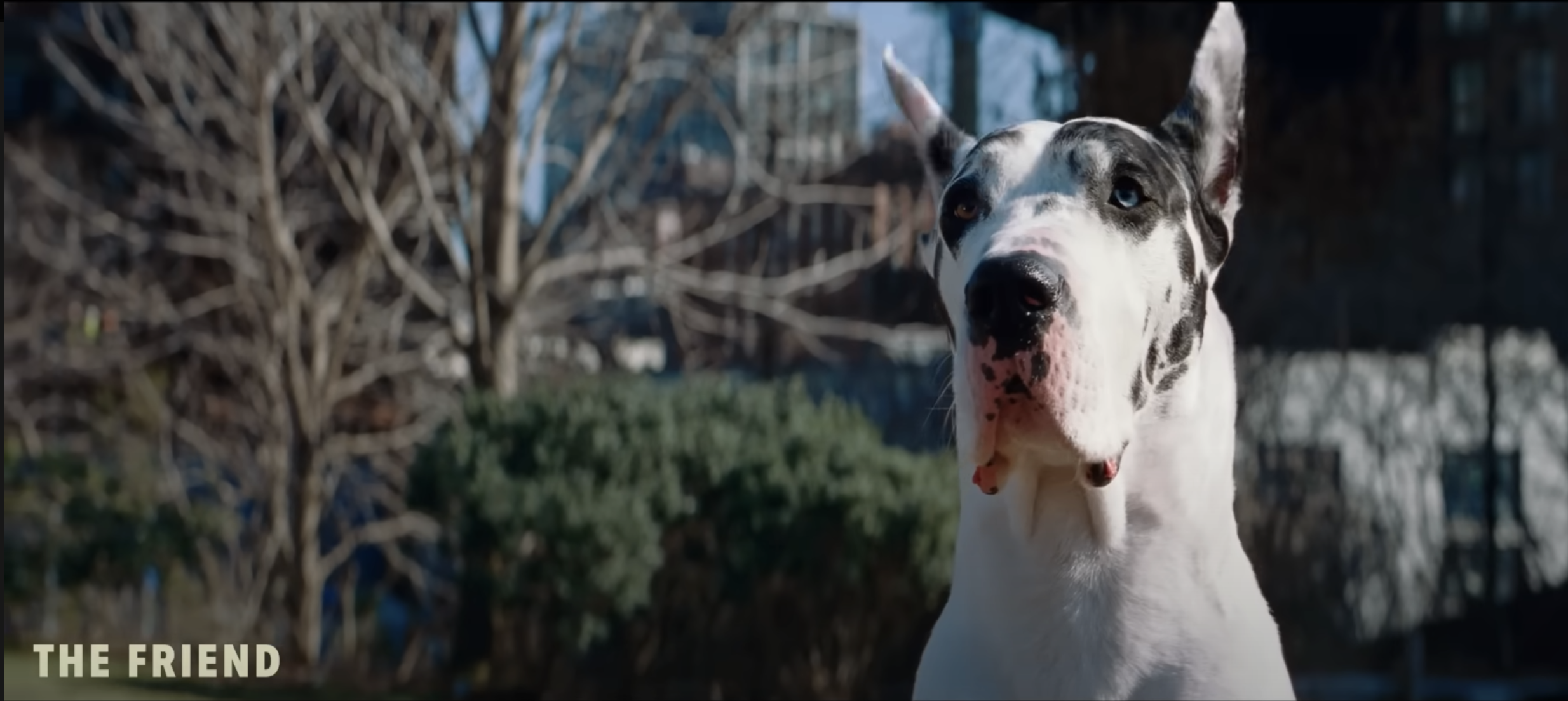
But wait I did, along with many other dog lovers as scheduling conflicts and then the actors’ strike delayed the movie again and again. As I followed the progress, I also peppered friends with quotes from people involved with the production. (“Being seen with a dog like this is like being seen with a rock star.”)
Four years went by before progress on the picture resumed. Bing was now six years old. Nunez was not involved in making the film but was nevertheless anxious about whether the big dog would hang in long enough to participate. Great Danes have many wonderful qualities, but longevity is not among them. The New Yorker article cites an average lifespan for a Dane as eight years. When we started our Great Dane obsession in the early 1960s, the stated average life span was seven years. And with the experience of living with nine of them, I can say that’s about right. We had one that lived past 10 years, but most were with us for far less time. It’s heartbreaking, but Great Danes are worth it.

Both of my daughters grew up with Great Danes, and of course, I hoped they’d get to see a film with a real Great Dane, not a cartoon version – or a cartoonish version, like the 2002 “Scooby-Doo” film. Ed and I went to see that one and were the only adults in the theater not accompanied by children. I hated it. I would have walked out — but I didn’t want to spoil the experience for the kids in the audience. I remember the film manipulates the dog’s mouth somehow so it seems as if he is speaking. It was creepy and dumb.
And then finally, earlier this year, “The Friend” was released in theaters. I went to see the film with one of my daughters — and loved every minute of it. Again, I was on a mission to encourage everyone to also go see the film. But movies don’t stick around in the theaters as long as they used to. In what seemed like no time, “The Friend” was no longer on the big screen. But then, wonder of wonders, I saw a notice that Netflix has “The Friend.” Finally!
I encourage you to watch “The Friend.” I will be watching it again.
Note about the art: At the top of the page, you will see my beloved Great Dane bookends (credited by the artist, Louise Peterson, as “Claynines”). We collected a lot of Great Dane art over the years — including several sculptures by Peterson (you can find her website here: www.danesculptor.com). A friend recently tried to count all the Great Dane art (including everything from sculptures and paintings to calendars and fridge magnets) in my apartment. I think she got to 80, but might have missed a few. After I saw “The Friend,” I was pleased to see one of my Dane figurines had similar black-and-white coloring as Bing.


 Patricia Nieder
You must be logged in to post a comment.