Ky-ote? Ky-o-tee? Whichever, They’re Here

CoyoteThe coyotes are out in force just now in our corner of northeast Los Angeles. A neighbor saw five or six walk brazenly down his street in broad daylight before disappearing down into the canyon below his house. The other evening, another neighbor a few doors away banged loudly on a saucepan while my daughter’s two terriers were barking up a storm. I thought she was complaining about the barking and rushed them inside. Turns out she was trying to discourage several coyotes from approaching any farther up the canyon onto her property. Someone else reported a coyote coming up on her deck and peering through the sliding glass door at her. She shouted and banged on the window until it left. So the pre-dawn cacophony we’d attributed to poorly restrained neighborhood dogs must have been a pack of coyotes.

To a couple of transplanted Easterners, it’s all pretty creepy. I’ve seen evidence of the animals ever since moving here eight years ago – mostly signs on trees for missing cats – but this is the first year I’ve actually encountered any. One morning as I walked my fortunately larger-than-a-coyote dog we stopped in our tracks and stared at a creature. A dog? A coyote? I spoke to a man stopped in his car. “Excuse me,” I said. “I moved here from the East. That is a coyote, isn’t it?” He assured me it was and suggested I change my intended route. The creature and my dog seemed equally curious about one another, but I took the man’s suggestion. Another evening we encountered a smaller coyote and again I hesitated to identify it. A neighborhood dog walker assured me it was a coyote. “A young one,” she said.”He hangs around this corner a lot. He’s probably been banished from the pack for some reason.” “Aww,” I said, “poor thing.” “Don’t even think of befriending him,” she said. Los Angeles County has laws prohibiting feeding coyotes and certain other wild animals, and we’re cautioned against leaving pet food and water outside at night.

As coyotes become increasingly comfortable with us, they become bolder – and more dangerous. Small dogs, cats and even young children become prey. And recently, a man in Colorado walking to work in the early morning was set upon by three coyotes who bit and scratched him for about two minutes until he managed to fight them off with his flashlight. Wildlife experts advise you try to make yourself as big as possible when encountering a coyote: Big shouts, big claps, big arm waves, bright lights. And don’t turn and run; rather, back away slowly.

I thought it might be interesting to add coyote sounds to this post so I went to soundboard.com and clicked on the first entry. Three dogs and one husband leaped up from their naps and into full alert mode. “What was that??” “Never mind; it was just me,” I said. “Go back to sleep.” I’ll let you find coyote sounds on your own.
This Leg

This leg was once able to swing effortlessly up on a ballet barre.  Or over my head while I balanced on the other one.  Along with its partner, this leg could clear the back, not just the seat, of a chair set in the middle of the ballet studio for giant leaps, a somewhat useless skill for a female dancer.  And when my father in his increasing impoverishment was quick to accept my half-hearted offer to quit ballet, I went on to other pursuits. Then this leg and its twin were able to reach over my curved back so the feet could touch the back of my head during a cheerleading jump.  It could do the splits.  And in college, this leg danced with a tall Norwegian man whose skill, and mine, caused others to step back, relinquish the dance floor and watch in admiration.

This leg walked in grade school and high school and college graduation ceremonies and into job interviews, and when I began working on newspapers, it took me out on assignments and then rested under the desk while I wrote my stories.  Once, when I’d climbed to the roof of an old mansion designed as a castle, the rest of me froze at the top and had to be coaxed down by the photographer accompanying me.  He held onto my legs and guided my feet down the iron bars imbedded into the castle walls.

This leg supported feet in pointed-toe shoes with spike heels whose metal core caused crescent-shaped indentations in people’s linoleum floors so that hosts began requesting women leave their shoes at the door.

This leg walked down an aisle and carried babies.  It helped children learn to walk and ride bicycles and drive a stick shift.  It walked alongside a long succession of big dogs on walks up and down hills, and it climbed innumerable ladders in many rooms of many houses that we owned so I could paint many walls.  This leg dug holes for planting plants in many gardens, and followed behind wheelbarrows hauling gravel for paths and topsoil.  We were hard workers, this leg and I.

And now, in my eighth decade, this leg is rebelling. When I try to get it to accept its share of my weight, it registers its agony.   “Maybe arthritis,” the doctor says.  One of the forms he has me fill out contains lists of activities and asks if I do them:  vacuuming?  Of course I vacuum.  Why doesn’t it also ask rug shampooing?  Or window washing?   Or, for that matter, sightseeing or trawling through art museums?  How about tromping around the ruins of Rome and Pompeii.?  This leg and I have been through a lot.

Now, I struggle with crutches and curse my awkwardness.

The newspaper had a story about an 80-year-old woman who slipped on the ice in her horse corral, lashed her legs together to stabilize the hip that broke in three places and dragged herself through ice and mud the 40 yards back to her house.  It took her four hours, and once she got inside the first call she made, before 911, was to her daughter 30 miles away, telling her she needed to come to feed the horses.

I want to be that woman.  I want to be like all those impressive old women I read about, women in their 80s and 90s who keep going in spite of the accumulating years.  Women who stare down old age and dare it to get in the way of what they want to accomplish.  Who refuse to accept the stereotypes of old age.  Who would not own a rocking chair if you paid them…

Damn!  When will that pain pill start to kick in?

I’ll Tell You a Story if You’re Old Enough

There are reasons why older people ought to hang out with one another.  I mean aside from when your eyebrows need tweezing and there’s a long gray hair growing out of your chin.  Your older friends’ eyesight is not any better than yours so they can’t see those things either.

Furthermore, you don’t have to feign interest in such things as blogging and tweeting and the existence of Facebook.  And let’s not even go there when it comes to popular music and that truly strange art form known as rap.  You can’t understand any of the words and have a feeling that it’s probably better that way.

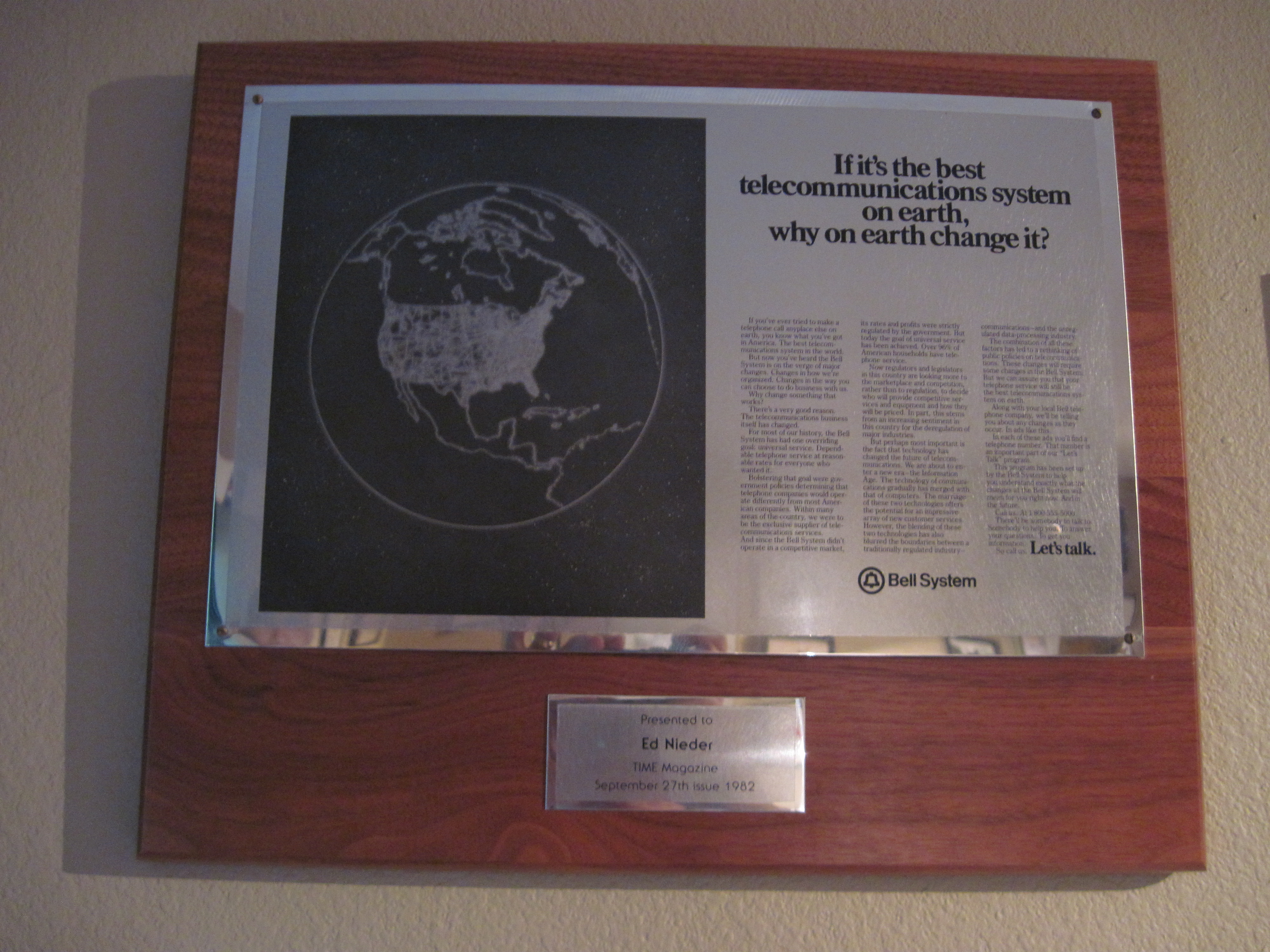
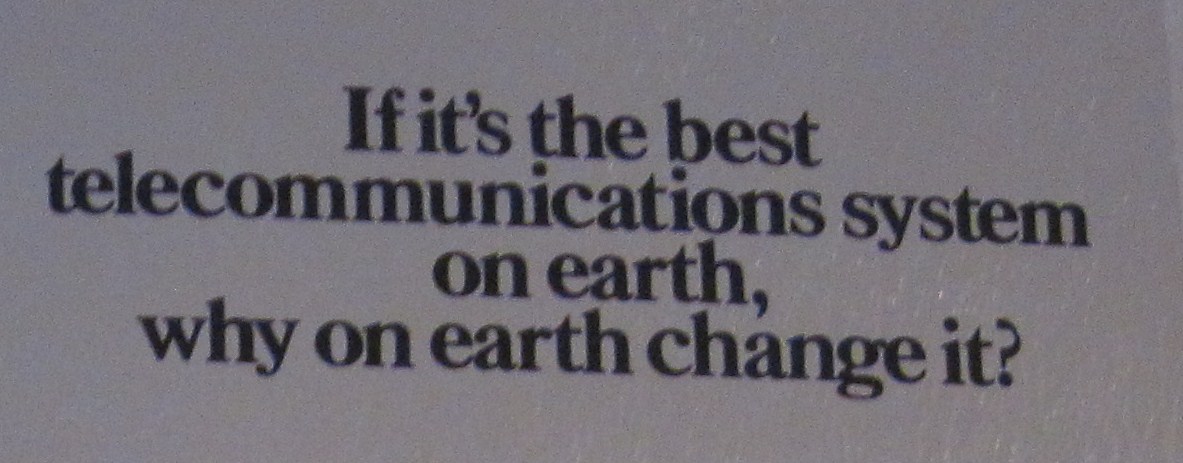
More important, though, is the matter of historical context.  Increasingly, I am noticing that I draw blanks from younger people at certain points in the stories I have been telling for years.  Like the time I mentioned that my husband had spent his career at the former Bell System.  The young person to whom I imparted that information said, “What’s that?”  “That,” for any young person reading this, was the nationwide telephone system whose efficiency was admired around the world and whose breakup in 1984 mystified the company’s counterparts overseas.  “If it’s the best telecommunications system on earth, why on earth change it?” was the headline on an ad at the time in which the company tried to explain itself.  My husband, who had a hand in creating that ad, said the company caved because an antitrust suit was threatening to drag on for years. And AT&T wanted to be able to compete in the marketplace that was changing the telephone business. Things such as those that now enable blogging and tweeting and the like.

Telephone ad 001Telephone ad 001

Recently, when I told some younger people that I had grown up in New Jersey, one asked why I did not talk like the Sopranos.  Well, for one thing, most people in New Jersey do not talk like the Sopranos.  But the question offered an opportunity for me to tell the story of the remedial speech course I was encouraged to take in college.

I enrolled at the University of Missouri where my Nebraska-born father was happy to send me, perhaps in the hope that I would lose some of my New Jersey accent and also because it was cheaper even for an out-of-stater than the Ivy League.  At the time, back then in the Ice Age, all freshmen were required to take a speech test.  As I recall, it consisted of standing in front of a group and speaking a little about where you were from and what brought you to the university.  As I’ve told the story, a fellow before me was wearing bib overalls.  That’s probably an embellishment but it enabled me to add, in an aside, that in those pre-hippie days I had never seen a person wearing bib overalls.  He related in what I considered a “country” accent that he was from a small town in Missouri and had come to major in agriculture.

I smiled to myself as he spoke.  My New Jersey home was just across the river from New York City, a place we New Jerseyans began making our way to as soon as we looked old enough to get away with lying about our age.  The drinking age then in New York was eighteen, unlike New Jersey’s twenty-one.  So I considered myself the ultimate sophisticate.  Of course I would breeze past this silly test, but that farmer fellow needed help.

So yes, he passed and I failed.  The speech professors trolling for students asked me to stay behind.  “We think you would benefit from our course,” one said.  I exploded.  “This is so unfair!  Just because I’m from a different part of the country.”

“Well,” the other professor said, “didn’t you come here for an education?”

“Yeah,” I said.

“When you leave here, don’t you want to sound like an educated person?”

“Yeah,” I said again.  “What do I sound like now?”

“You sound like a gun moll.”

Now when I tell this story, I get blank stares at the end from younger people, which is disconcerting since it makes the punch line fall flat.  I guess you had to grow up reading Dick Tracy in the comics to know that a gun moll is a gangster’s girlfriend.

I did take the course and learned to watch the pronunciation of certain vowels.  I also spent four years in Missouri and then moved back and forth across country several times.  Once in San Francisco I was being considered for a job in television because, the interviewer said, I had no noticeable regional accent.  I chuckled to myself at that one.

Younger people probably aren’t aware that consumer interest – car loans, credit cards, department store accounts and such – once was tax deductible on a person’s income tax.  A daughter who just learned this was shocked.  “What was the rationale for that?”  Probably a ploy, I said, to get us all hooked on buying on credit.  And look where that got us.

So another of my stories to retire.  Back in our younger days, we filled out our own income tax returns, and sometimes we were audited.  For one of those audits, my husband gathered up all the statements we had accrued in the year and took them in to an IRS office to present to the auditor.  “Where does it show the interest?” she asked.  “I’ve never had a credit account.”  Oooh boy, my husband thought, we are in trouble here.  And we were – until we settled with them.

I have been thinking lately that I need to retire these old stories and find new things to talk about.  But I tell you, I refuse to do it in a tweet.

Thank you, Mr. President

Dear President Obama:

I’m writing to thank you for nominating Janet Yellen as chairman of the Federal Reserve. I was worried before when it looked like you would nominate that other guy. You may have seen my name on a petition or two about that. But you came through and so I will not have to relegate your cardboard effigy to the study closet. It will continue to stand by my desk as it has since December 2008 when my daughter sneaked into our house and set it up by the Christmas tree. After the holidays, we moved it down to the study. During the dopy “birther” business, Ed hung a copy of your official birth certificate around your neck.

Alison received the life-sized cardboard cutout as a gag gift at an office holiday party, one in which people are allowed to switch presents with other people if they wish. But everyone knew this gift was earmarked for Alison’s mother and off limits. I must admit there have been times during the past five years when I have considered moving it to the closet, but I figured an awful lot of the problems you were dealing with were not of your making. Honestly, I don’t know how you can remain so calm in the face of the nonsense. Perhaps, in the privacy of the residence or on vacation in Hawaii you are able to scream and curse and throw crockery about. I know I would.

But I remain, as I assume you do, hopeful. About a lot of things (health care reform, ending wars, a return to civility, etc.) but most of all right now an end to the Never-ending Great Recession. Yes, I know the experts say it ended some years ago. But if that’s so, why do we still have so many people unemployed and under-employed and why has the gap between the rich and poor become a chasm? And everyone’s in a bad mood. I hope that new leadership will help give the Fed a more pro-active role in developing policies to alleviate some of that.

Now let’s just hope the crazies don’t derail the confirmation.

Sincerely,

Patricia Nieder

Obama 2

Remembering Bill Eppridge

Bill Eppridge died, and the obituaries were justifiably effusive in praise of his photojournalism artistry. Our little group that hung around Max’s, the bar and grill across from Missouri’s J-School, always knew he was destined for greatness. Didn’t he win first prize in a National Press Photographers Association competition while still in school, as well as being named College Photographer of the Year two years running? (We always wondered what he did with two sets of encyclopedias.) The rest of us sat drinking beer and eating Max’s delicious and economically priced  hamburgers while reassuring ourselves that we were never going to “quote, prostitute our talent,” but Bill would be roaming the room, the always–present camera in hand on the chance a promising picture presented itself.

After college he was an intern at Life magazine and then went to work for National Geographic until returning to Life where he remained until that magazine’s demise. He also worked for Time and Sports Illustrated.  He was at Life when he volunteered to cover Senator Robert F. Kennedy’s campaign for the Democratic presidential nomination in 1968. Kennedy won the California primary and had just delivered his acceptance speech at the Ambassador Hotel in Los Angeles when he was shot by a lone assassin in the hotel kitchen. Bill’s haunting photo of the senator sprawled on the floor, his head cradled by a distraught busboy, became an iconic image, one of many in that violent chapter in our nation’s history. The obituaries say the death of Bobby Kennedy, whom Bill had grown close to, marked the rest of the photographer’s life. He covered other political campaigns, including part of George McGovern’s presidential run, but it was never the same.

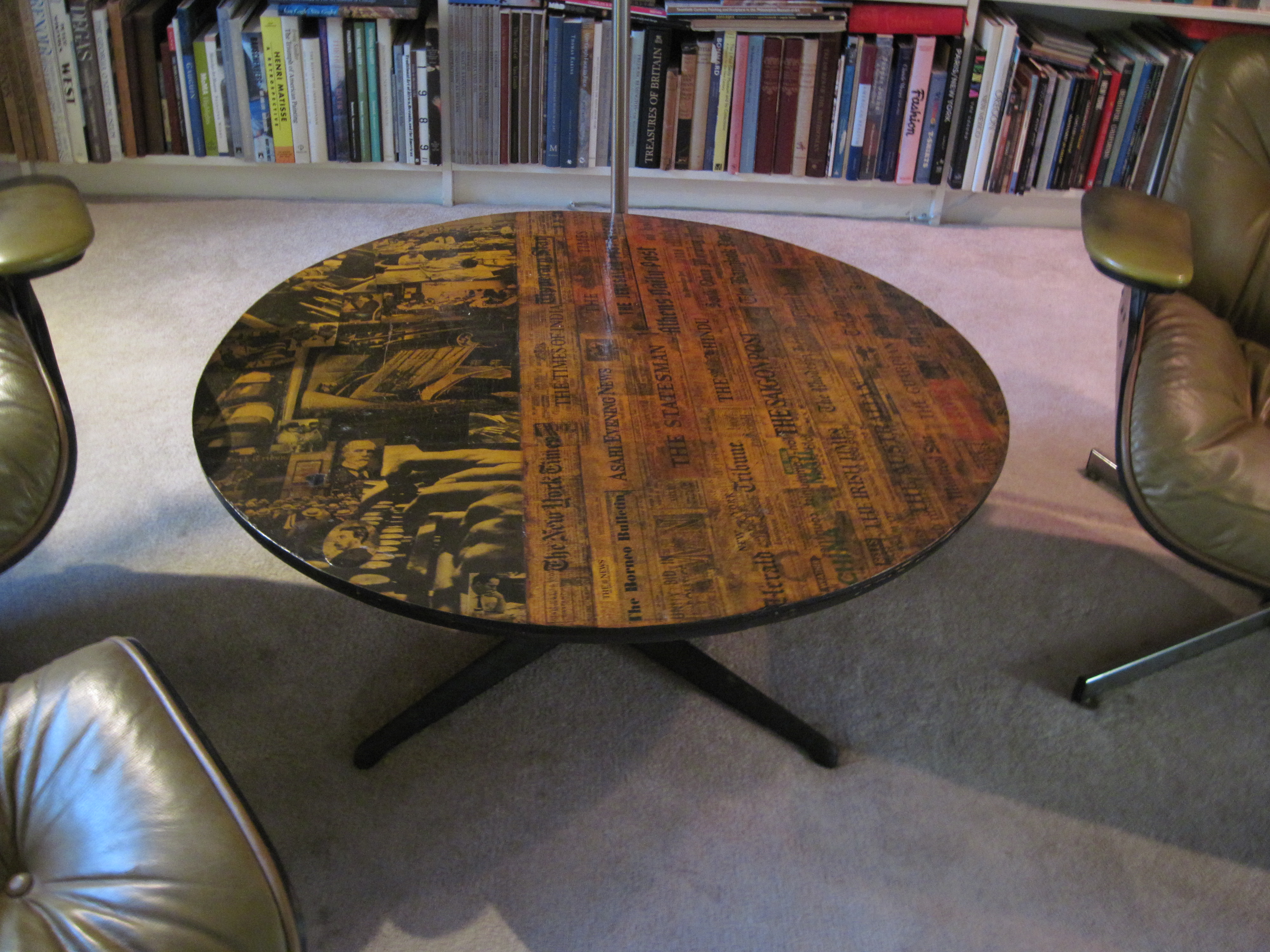
Bill’s book, A Time It Was – Bobby Kennedy in the Sixties is on display in our home library and his photo of the last issue of The New York Herald Tribune coming off the press is part of a journalism-themed coffee table I decoupaged many years ago. We look at it every day as we drink our morning coffee and read two newspapers. Our journalist daughter has dibs on the table  when we die, but I wonder if she and her friends will recognize some of the images: the pressmen in their paper hats, the hands of a page makeup guy arranging metal type, the linotype and teletype machines, and of course the newsroom with rows of desks and typewriters. That was a time as well.

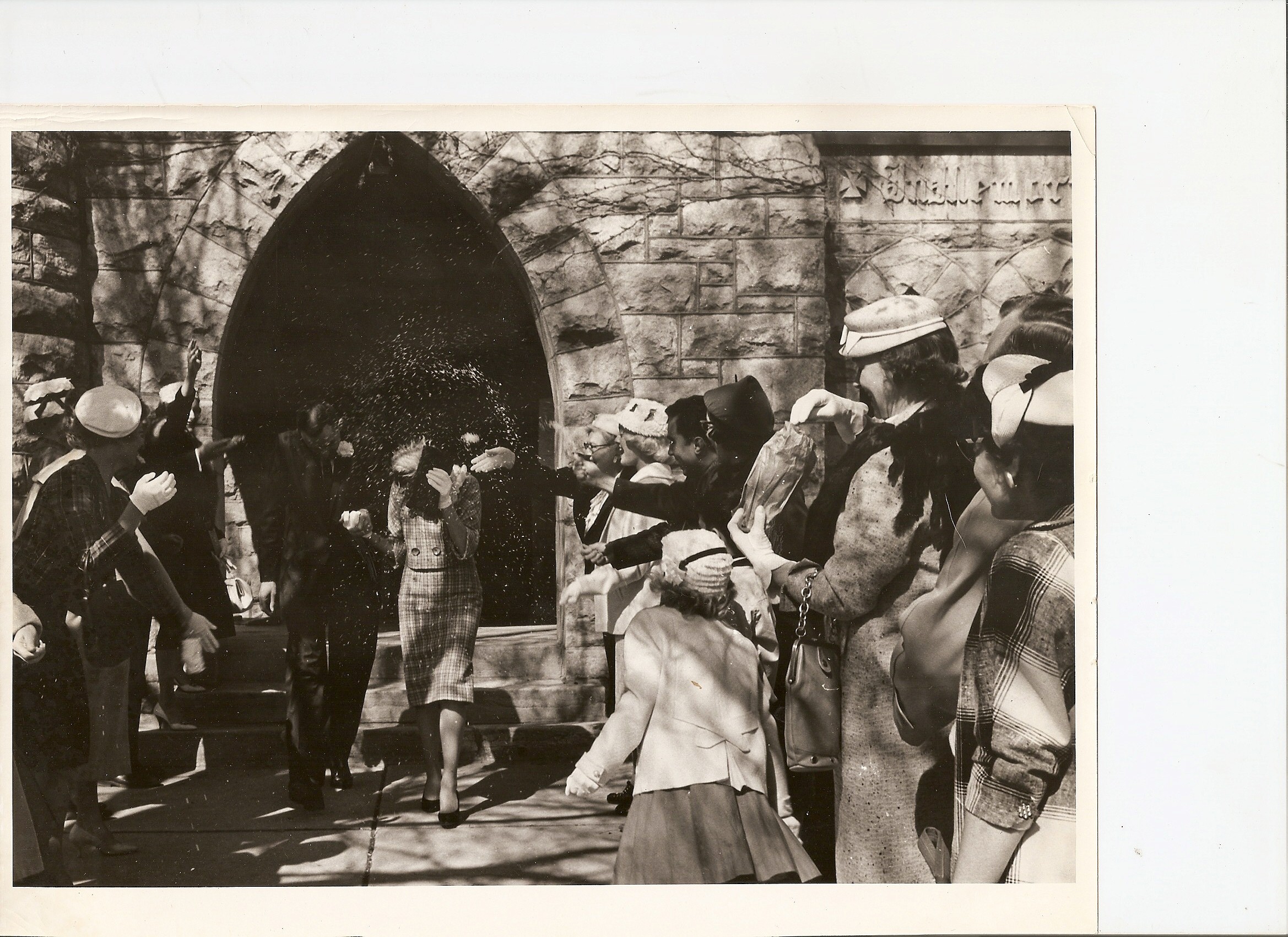
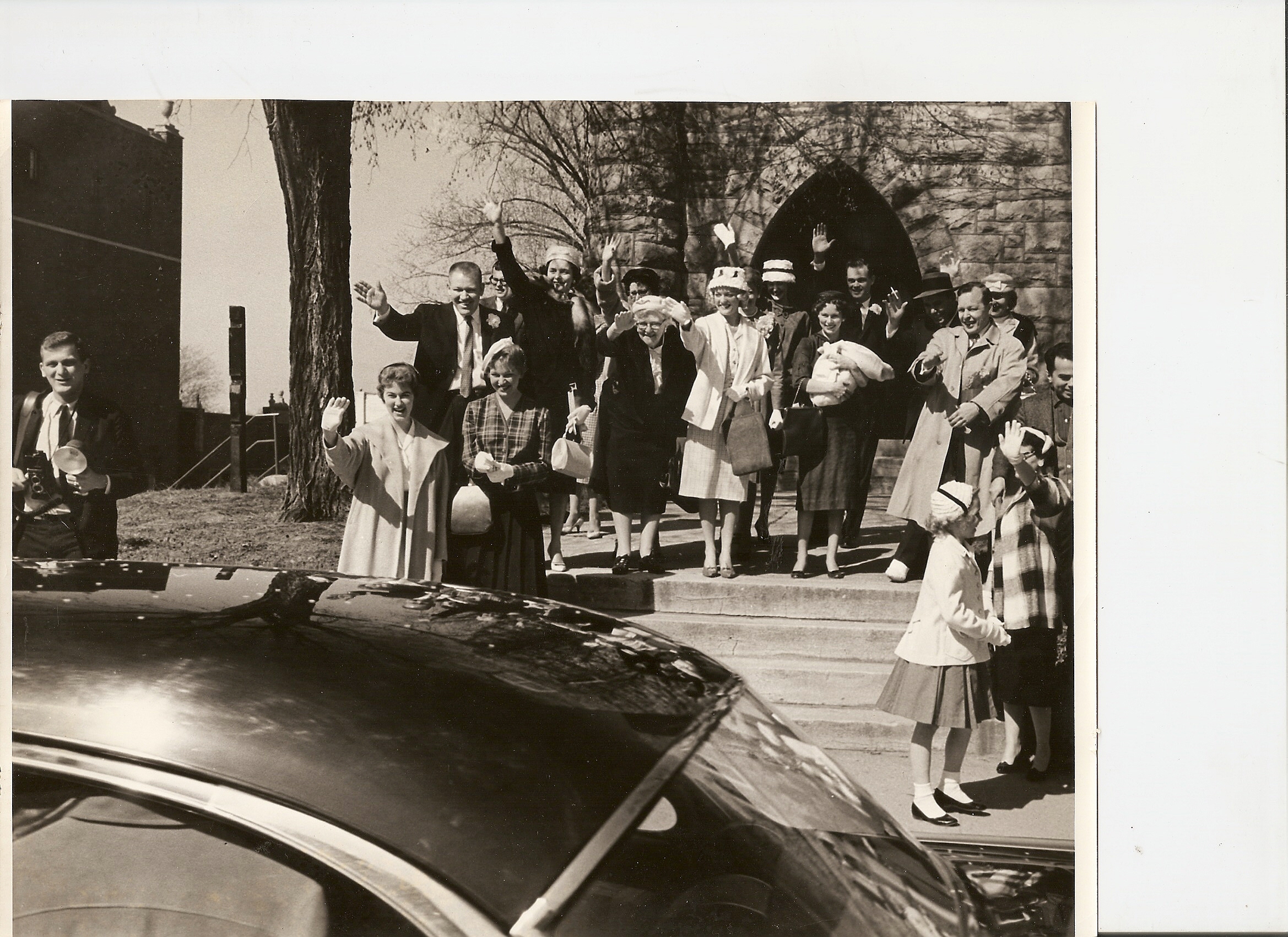
In an impetuous move that became symptomatic of much of our life together, Ed and I decided to marry two months before my graduation. Bill and another old J-School friend Mort Engleberg took pictures. You know how wedding photographers frequently take pictures of the bride and groom waving from inside the car? Bill’s photo was shot from beside the car to show all our friends waving to us. Brilliant, and much more meaningful.

We admired Bill’s career from a distance, losing touch with him and the others from Max’s. A few years ago we read of the death of an especially revered editor at The New Yorker and realized it must have been our old friend Pat Crowe. For thirty years we lived across the river, fourteen miles from Manhattan, and didn’t know he was there. That’s very sad. My daughter says that thanks to Facebook her generation will not lose track of friends from college and other times in their lives, and I suppose she’s right. At this point in my life I will have to wait for obituaries and the nostalgic reverie they engender.

weddingwedding guests

TableTable top

[Wedding photos, Herald-Tribune photo: Bill Eppridge]

Strawberry Dreams

There’s something insidious about the Internet. Well, actually, there’s a lot insidious from the threat of identity theft on down. But what I have in mind this time is the way ads stalk you and pop up at the most inconvenient times.

An example: You’ve checked a site that sells fancy dipped strawberries, and in fact have returned several times to the site trying to decide just which fancy dipped strawberries to send as a gift. Then as the never-ending Great Recession continues, you decide to check a site for bankruptcy lawyers, just in case it comes to that. Up pops an ad for fancy dipped strawberries. It is a morality lesson right before your eyes. If you hadn’t spent a lifetime being tempted by such things as fancy dipped strawberries, you would not be possibly in the market for a bankruptcy lawyer.

The morality lesson continues when you switch from looking for a lawyer to checking your email where you find the United Farm Workers urging your support for strawberry workers in California. The workers protested unsafe working conditions and won, the UFW says, but now are being discouraged from unionizing to assure further protection. And I just contributed to their woes by buying those fancy dipped strawberries. So we can add guilt to my sin of avarice.

My daughter explained how those pop-up ads work but my short term memory loss that comes with old age deleted the information almost immediately. Something about cookies, I think, and there are good cookies and bad cookies, unlike in real life where cookies are both good and bad – good tasting but bad for the waistline. But probably very nice with fancy dipped strawberries.

We seniors  ̶  isn’t that a wonderful term? makes you feel like you’re back in high school  ̶  apparently suffer short term memory loss because we don’t get enough sleep. Or the right kind of sleep, the kind that helps store short term memory. A friend sent me a test (on the Internet of course) in which you look at two groups of faces and then report whether you remember ever seeing those faces before and, the hard part, where you’ve seen them. I scored 100 percent on the first part and exactly at the average mark (for old people) on the second. That explains why here in Los Angeles I keep seeing people who look vaguely familiar but can’t tell where I’ve seen them. They could be actors I’ve seen in movies or on TV – or someone from the supermarket.

The people who devised the faces test say I could improve my short term memory by sleeping more soundly. And that, I’ll bet, would come by not thinking about the Great Recession With No End. Or strawberries.