
Until the latest issue of The Adelphean arrived in my apartment’s mail cubby, I had no idea that PBS News Anchor Judy Woodruff and I were sorority sisters — albeit in different decades and on different college campuses, not to mention way different degrees of journalistic achievement. But she is someone I’ve always admired, and before I became addicted to watching political coverage on MSNBC — not just nightly but many times throughout the day depending on breaking news alerts — I was likewise addicted to the news coverage presented by Public Television. Those two companies, plus CNN, are my go-to sources for honest, forthright TV news coverage.
Woodruff’s more than five decades of experience covering the news earned her the distinction, in the opening words of Rebecca Desensi Sivori’s cover story introduction, “As one of the most trusted names in journalism.” It also made her a logical choice to receive the inaugural Peabody Award for Journalistic Integrity last June. Beginning in 1940 at the Grady College of Journalism and Mass Communication at the University of Georgia, Peabody Awards are presented annually in such categories as news, entertainment, podcast/radio, public service and more. The awards committee could not have chosen a better year to rectify an overlooked and much-needed category for recognition. The awards website seemed to acknowledge as much with its statement that Woodruff’s award “honors the sustained achievement of the highest professional standards of journalism, as well as personal integrity in reporting the news in challenging times.”
Desensi Sivori, Central District Adelphean editor, also acknowledged the award’s significant timeliness as she began her interview, coming as she observed, “during a period of history where there seems to be a growing distrust of media outlets.”
Asked what integrity in journalism means to her and how she has implemented the principle in her career, Woodruff replied, “Integrity goes to the core of what we do as journalists. It is all about telling the truth. It’s about being faithful to the facts, to fairness, to treating people we cover with respect. At the same time, we hold people in positions of power accountable. It goes to the very essence of what we do as journalists, and especially those of us who are privileged to cover government officials, elected officials, the people who make decisions for all of us. It goes to the heart of what we do and who we are, and so this award means everything to me.”
Originally planning on a career in government, Woodruff was advised by a colleague to consider covering politics instead. Soon to graduate in 1968 with a journalism degree from Duke, she followed his advice and drove to Atlanta over spring break where the only entry level job opening in television was at WQXI. There the news director offered a position as newsroom secretary. When she stood to thank him, he said, “Of course. Besides, how could I not hire someone with legs like yours?”
Ah yes. The more things change . . .
I found this article fascinating of course even though my own experience entering the journalism field dated from the previous decade. Graduating in 1960 with a journalism degree from the University of Missouri, I had the luxury of an employed husband that enabled me to get my foot in many newsroom doors by filling in for vacationing secretaries while waiting for a reporter opening. The first of these was at the Sacramento Bee after a brief stint in their radio station upstairs. At the time, The Bee had no intention of overruling the city editor’s injunction against women reporters, so I filled in for a vacationing secretary until landing a reporting job in the women’s department. Likewise, at the San Francisco Chronicle where one lone woman held fast to the only female-held city room job. Finding myself alone in the elevator one evening with that paper’s city editor, I confronted him about his gender-diversity situation and was told he did not hire women because they cried when he yelled or cursed at them. I’m sure I was not quick enough to point out that expletive-laced New Jersey-speak was my native language and that it could be resurrected as needed anytime. Also, there was no way I’d let him and a city-room full of male reporters see me cry.

I’m sure the news director’s comment about Woodruff’s legs was met with an indulgent if long-suffering weak smile. Having had a front-row seat observing the move of women into formerly all-male workplaces, I must point out how much worse it’s gotten through the years. When I made my way down the steep steps to The Bee’s press-room, teetering in spike heels and pencil-skirt suit, the pressmen with paper hats and ink-stained fingernails could not have been nicer. Just as long as I knew not to touch with anything but the tip of a pencil any portion of the lead type page form I was there to examine. (Doing otherwise would cause the entire room to empty out on strike.) Likewise, the San Francisco Chronicle photographer whose Iwo Jima flag-raising photo garnered him respect and awe among young newsroom staff but still years later was required to drive a woman’s department reporter to a society function photo assignment. He was pleasant and courteous to me as well.
What happened in the intervening years? I guess back when women’s presence was a rarity, men behaved as they did outside the workplace. But as more and more women moved into previous men-only workplaces, they were seen as threats. Or is it part of the general coarsening of American society overall? In the 1980s, I took a job as public relations director at a state college, now university, and my boss, a man, related how my addition to the non-teaching professional staff on campus was greeted by a contingent of men in one particular testosterone-heavy office. “Does she fool around?” they asked. My boss said he didn’t know but that I was married and that my husband was very tall!
Ed and I had a good laugh over that. Good grief.
The Adelphean is a quarterly educational journal of college life and alumnae achievement. It is the official publication of Alpha Delta Pi, oldest secret society of college women in the world, founded May 15, 1851 at Wesleyan Female College, Macon, Georgia, the world’s first chartered college for women.
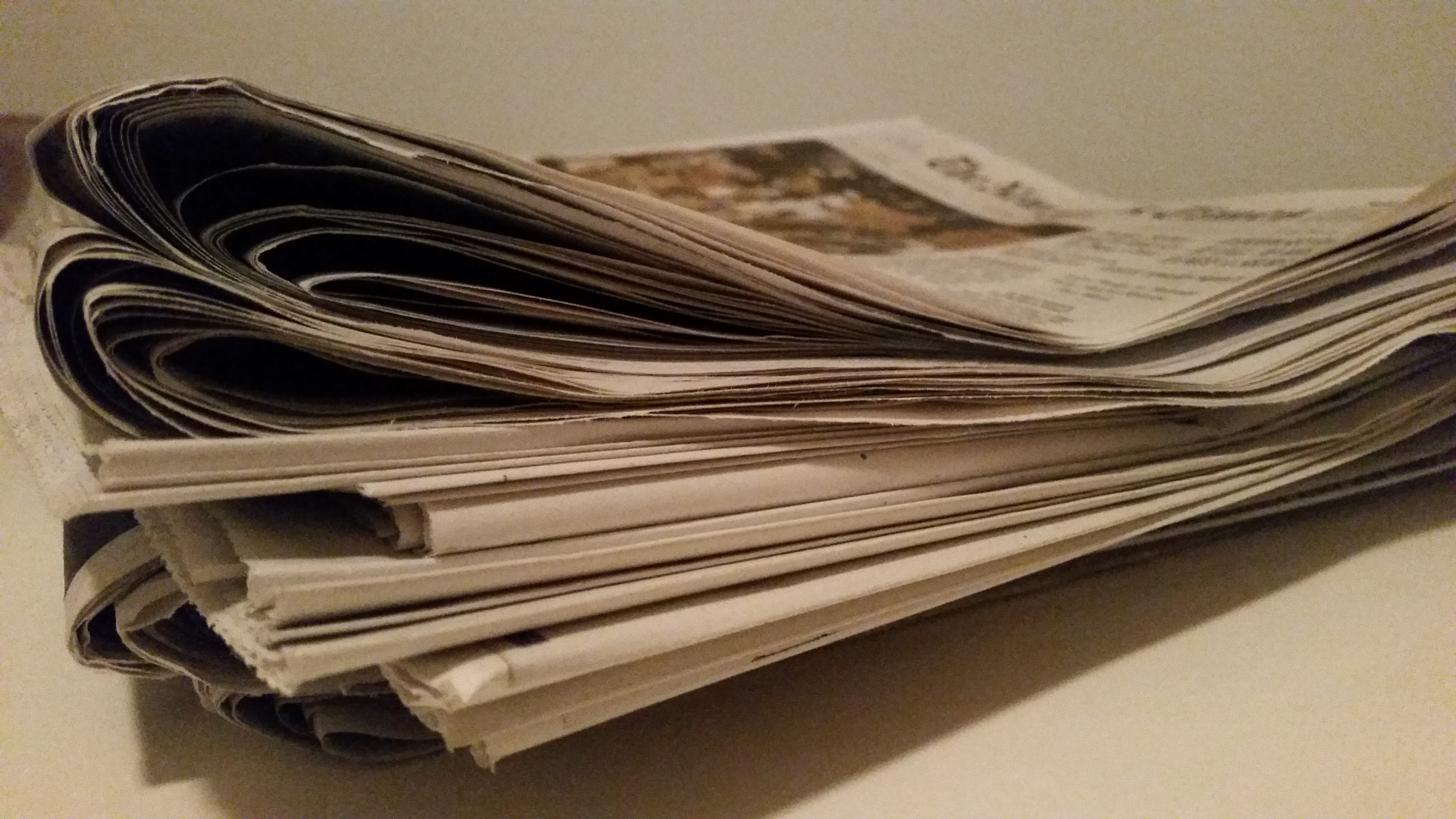
 Yesterday was a good day for a journalism junkie. Heeding a call from The Boston Globe, more than 300 newspapers across the country ran editorials reminding readers, as The New York Times put it, “of the value of America’s free press” and affirming “a fundamental American institution.”
  But now for the other enablers. Rachel Maddow, whose MSNBC programs are must watching every day for me, said something during this whole intolerable mess our country is involved in now that struck me. She, whose journalistic background has been limited to broadcast, pointed out that nearly all the substantive information that has been unearthed about Russian interference in our democracy has come from print journalists, specifically, from those working for large publications with sufficient staffs and time for digging. Broadcast outlets with the tyranny of time to fill can report the result of that digging — and are doing so. But as Maddow pointed out, it takes both endeavors to get at the truth. And it’s no secret that newspapers of all sizes are struggling. She then looked directly into the camera and encouraged her audience to help save print journalism by subscribing to their local newspapers. How can I not?
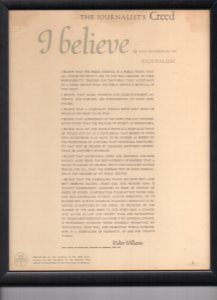 Oh, the pain of it! Walter Williams must be spinning in his grave. He founded the first ̶ IN THE WORLD ̶ school of journalism at my alma mater, the University of Missouri. He traveled the world extolling the principle that journalism is a profession requiring serious university study and accompanying respect. As outlined in Wikipedia, other colleges and universities began to emulate Missouri’s invention, and “Williams became increasingly concerned they would not adhere to the same high journalistic standards being taught at ‘Mizzou.’ So in 1941 he created the Journalist’s Creed, a statement of professional guidelines often evoked as the definitive code of ethics for journalists. It is posted in bronze at the National Press Club in Washington DC.”
 That’s a headline I had been planning to write for most of this month, but the crush of daily life kept me from it. And then, day by day the story kept growing until today we learn that the sexual harassment suit filed by the former Fox News anchor against the odious Roger Ailes has led to
  In
In 


 Patricia Nieder
You must be logged in to post a comment.