I Miss Snow

The weather out there in much of the country is frightful, but I’m sorry to report that here in Southern California it’s pretty darn delightful. Don’t hate me for it because, truth be told, I miss snow. Maybe not in the record-breaking amounts being experienced this year (still think climate change is a hoax?) but some.

Our New York daughter, while dreading the coming next onslaught, sends us video from her apartment window of the initial snowflakes. I voice my sympathy for the struggles that will ensue but can’t help mentioning how beautiful the scene is. Likewise, with the photo a friend sends from Providence showing a frozen river not too far from her front door. It’s so beautiful!Providence River

But Boston — good grief, poor Boston –– has run out of places to stack the snow. Trucking it to outlying fields and considering various water bodies in which to dump the stuff.

I try not to mention that the weather here is balmy, in the 80s with just the hint of a soft breeze or that the jasmine by the front door is beginning to bloom, sending its intoxicating aroma throughout the house. And I know they won’t believe me when I say that I miss snow.

I miss the hush that comes over a neighborhood when snow covers the landscape and before the snowplows and snow blowers get to work. And even afterwards, if you’re lucky enough to score a snow day, the forced confinement that feels like a particularly special gift, a time to read a book or watch a movie – or even to tackle some long-avoided project like organizing family photographs or sewing buttons on an old sweater that is down to just two.

Ed does not share my nostalgia for snow. He grew up in Colorado and doesn’t care if he never sees another flake. And he’s fond of saying that the best part of the house sale when we were moving from New Jersey was watching the snow shovel walk out the door.

(And speaking of my much-maligned home state, I have been trying to come up with a way to share Buzzfeed’s 22 Reasons Why You Should Never Visit New Jersey. It includes photos of snow but a great deal more. Showing it here is a stretch, I know, but something to look at it if you’re snowed in.)

So how’s this for an idea? Instead of building a pipeline to transport tar sands oil from Canada down to the Gulf region, why not a pipeline going across the country from east to west to transport snow from the beleaguered snowbound regions to the parched western states. They’d have to find a way to filter out the street pollution that’s mixed up in all that snow but hey, this is America. Didn’t we used to be a can-do nation? Let’s put our minds to it.

In the meantime, enjoy your snow day. Unlike you, I have to work in the yard.
This Epidemic Didn’t Need to Happen

“Disheartening” was the word used by the Orange County health officer to describe the fact that a disease that had been all but eliminated in the United States in 2000 is now the cause of an epidemic spreading from Southern California to several other states across the country and into Mexico. NPR’s Melissa Block had asked Dr. Eric Handler his reaction to the situation that had its start before Christmas at Disneyland, carried by one unvaccinated tourist and spread rapidly among several native-born citizens who had not been vaccinated. The highly contagious disease is one that we tended to lump together in our minds with all those childhood ailments that, one by one, were brought under control by the development of a vaccine.

As a young mother, I remember marveling that our children could be protected from diseases that we suffered through in our own childhoods: whooping cough, measles, rubella (German measles), mumps. Once the disease had passed you were pretty much assured of having natural immunity. (My younger brother came down with chicken pox and we both were quarantined, a bold sign on the front door warning others away. I was spared and years later, when both my children had the disease, I cared for them and was again not affected. So when a physician suggested I go for a newly developed anti-shingles vaccine for anyone who’d ever had chicken pox, I could happily decline.)

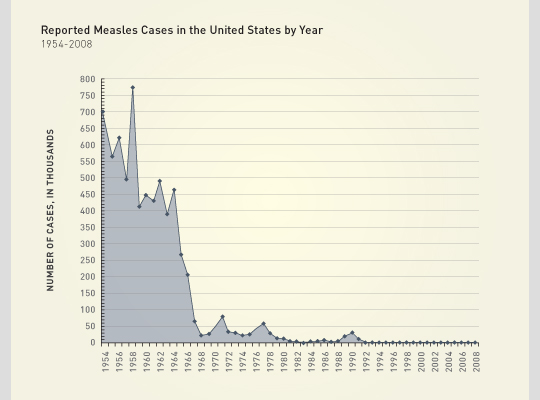
An earlier NPR report noted that anyone born before 1959 is protected from the current measles epidemic because it would be assumed they’d had the disease as children and carried natural immunity. Before the vaccine was introduced in 1963, the U.S. experienced some four million reported cases a year. In 2000 the number was zero.

And now it’s back. Even before the current epidemic, the CDC reported that 2014 saw a record number of cases — 644 from 27 states. The reason is a growing anti-vaccination movement that finds parents opting out of vaccinations for their children based on fears resulting from a report, since discredited, of a link between inoculations and autism. Major scientific organizations all refute the claims. Now, a generation of doctors who have never seen measles is frantically trying to catch up on the symptoms and treatment of the disease. Untreated or treated late, measles can lead to serious complications, even death.

Measles graphA strongly worded editorial in The Los Angeles Times calls for an end to the practice of allowing parents to opt-out of immunizations requirements for their school-age children on the basis of “personal beliefs.” The outbreak has illustrated “how a highly contagious disease can spread when the vaccination rate falls below the level needed for ‘herd immunity,’” the paper wrote, explaining that herd immunity means “that so many people are immune that the chance of outbreak is low, which protects the few who are not immunized because they are too young to have been fully vaccinated or because they are among the few in whom the vaccine doesn’t ‘take’ or because they haven’t been vaccinated for valid medical reasons.”

As the paper stated in another editorial, “Getting vaccinated is good for the health of the inoculated person and also part of one’s public responsibility to help protect the health of others.”

Once again, we must be reminded that we’re all in this together, folks.

Graph: U.S. Centers for Disease Control & Prevention

Remembering Newark

My cousin sent an article from The Guardian describing changes taking place in Newark, New Jersey’s largest city and the last place many people would expect to ever see gentrification. While a third of the city’s population lives below the poverty line, business is booming in downtown Newark and New Yorkers priced out of their city’s housing costs are eying the neighboring city 10 miles to the west. Xan Broooks, the article’s author, repeats a quote from former Newark Mayor Kenneth Gibson: “Wherever American cities are going, Newark will get there first.”

Dorothy grew up in Newark and my family’s home was in the nearby city of East Orange. (At college in the Midwest, my 220px-East_Orange_City_Hall_Lincoln_jehhometown’s name drew snickers and comments like “East Orange. Is that anywhere near West Lemon? Yuk, yuk.” Of course, here in Southern California I get none of that since a great many place names pay homage to assorted varieties of citrus. New Jersey’s Oranges – Orange, East Orange, West Orange and South Orange – reflect this country’s original status as England’s colony and acknowledge such people as “William of …”).

Essex County (another nod to England) was a wonderful place for a childhood with parks and playgrounds, safe tree-lined streets with sidewalks, and excellent schools. My old elementary school, Franklin School, now The Whitney E. Houston Academy of Creative and Performing Arts, sat across the street from a branch library and a big expanse of green parkland with a brook running through. Not exactly the picture many people have when they think of New Jersey. Whitney Houston was one of many famous people who have called East Orange home – and many still do.

Whitney Houston SchoolEast Orange was a city and Newark was the bigger city close by where we dressed up to ride the bus for back-to-school shopping and lunch at Schrafft’s. Newark was where I went for ballet classes, riding the bus downtown by myself and walking over to my father’s office and then with him to the Margit Tarasoff School of Russian Ballet, where Mme. Tarasoff taught classes and where occasionally her husband Ivan appeared. Then bent and walking with a cane, he had been a star dancer in Russia. When he appeared in the studio to observe (and critique), we students were terrified. Mme.Tarasoff, born Margit Leeras I learned years later (thank you, internet), had been a ballet star in her native Norway.

As for the really big city of New York, that was where we went on special occasions, say to attend the Christmas Show at Radio City Music Hall and, maybe once, to see the Macy’s Thanksgiving Parade, or to eat at the Automat, that deliriously child-friendly restaurant with individual dishes of food behind glass doors that opened when the requisite numbers of coins were inserted and the handle turned. So much more fun than a cafeteria.

And these are just a few of the memories The Guardian article generated for me. I wish Newark well in its upward climb. But I hope it will be able to accomplish that without leaving its longtime residents behind in gentrification’s dust.

default_thumbPhotos: East Orange City Hall; Whitney E. Houston Academy of Creative & Performing Arts, East Orange;New Jersey Performing Arts Center, Newark

Drought. Really?

after stormDriving home, I heard the ping indicating a text message, and when I pulled up to the stoplight, read from a friend on the East Coast: “Wondering if you are safe and sound. The storms in LA are scary!” I pointed my phone straight ahead and sent her this picture. “What a beautiful day!” she wrote back.

And it was, at that point. The sky looked almost celestial. All that was missing was a trumpeting angel or two.

When I got home I wrote my friend that yes, at times the storm was scary. During the night before, the roaring winds and sheets of rain woke us. Our Great Dane Lotte — who, unlike all eight of her predecessors, never gets on the furniture – climbed up in bed with us. The next day gave us a cornucopia of weather patterns: rain, sunshine, more rain, more sunshine, dark menacing clouds, clear blue skies with puffy white clouds hanging over the mountaintops. California weather is nothing if not dramatic.

But we’re in a drought and will continue so for a long time, say government officials and water professionals, a fact that Los Angeles Times political columnist George Skelton finds annoying. “Highways have closed because of flooding. Cars have been hydroplaning and been swept off roads. Creeks are leaping their banks. The Los Angeles River has become a real river. That’s hardly a drought,” he wrote.

He chided officials for their doomsday talk and urged them to come up with a better definition for the current situation. “How about simply calling it a water shortage?” he wrote. He also challenged them to start moving on worthwhile projects to avoid future drought conditions. The voters approved a $7.5 billion water bond but, he’s told, it will take at least three years for projects to be selected and construction begun.

This drought thing has been going on for many years, and most people are doing their best to not waste water. It’s about time that politicians and special interest groups stop just talking about drought and start doing something about it.

Abbondanza? Of Course!

In anticipation of Thanksgiving, The New York Times printed a state-by-state rundown of favorite dishes that might grace those holiday tables. As a half-Italian person who grew up in New Jersey, I was glad to see the entry for that state included baked manicotti. The writer of that piece states, “For many Italian-American families, in New Jersey and elsewhere, the Thanksgiving smorgasbord doesn’t feel quite right without a little touch of red sauce.”

Thanksgiving, Jeff Gordinier points out, “also represents an American expression of abbondanza, the Italian concept of too-muchness that makes a meal feel epic.”

The manicotti recipe sounds lovely, made as it is with crepes rather than pasta to make it lighter and less filling. I will try it sometime. But not at Thanksgiving. My family’s tradition calls for lasagne, made in as close an approximation as possible to my grandmother’s, and served as a first course prelude to everything else.

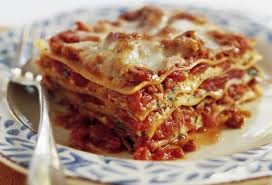
lasagneIf you happened to drop in to my grandparents’ house in the days preceding any major holiday, you’d find Grandpa spreading sheets of paper over the high back wooden chairs that would then be covered with strips of pasta dough that he took from Grandma as she finished making them. The fresh dough would be allowed to dry and then be assembled into layers with cheese (ricotta, mozzarella and parmesan) and homemade tomato sauce. When the day of the dinner arrived, the oversized iron stove fairly glowed, filling the house with an assortment of delectable aromas. Once everyone was seated at the long dining room table, the baked lasagne was brought in and placed before Grandpa who cut the first square and declared it “a perfect brick,” just the right consistency of layered pasta, cheese and sauce.

Grandma’s lasagne was incomparably delicious, and unsuspecting newcomers to the holiday table gladly accepted offers of second helpings. Then, to their dismay, came the rest of the meal: the meat (which type dependent on the holiday), potatoes, vegetables, assorted relishes, bread and finally, a simple lettuce salad dressed with oil and lemon juice. Dessert was also fairly simple because cake would be served later at a follow-up supper.

Ed and I have continued the lasagne tradition at all our holiday dinners. It came in handy when increasingly more diners were vegetarians; you knew they wouldn’t go hungry if they passed  on the turkey, roast beef or ham. But I’ve never been able to figure out how Grandma managed to put together the follow-up supper, even though it consisted of little more than sliced meat and cheese, bread and crackers – and cake. One gargantuan meal is the most we can pull off in a day.

[Photo: mondoricette.forumfree.it]

Of Pine Cones and Mosquitoes

The women on their daily walk switch from Chinese to English when I stop to chat. One day the topic was pine cones as one woman was carrying home one of the large cones that fall to the ground. They quoted another Asian neighbor: “She says if you put pine cones by your door, you won’t get mosquitoes in your house.”pine cones

Hmm, I thought, something to do with the cones that fall into our yard from our neighbor’s tree. Better than leaving them on the ground to be chewed on by the dog. And mosquitoes are becoming more of a problem in Los Angeles, especially with the appearance of species that can transmit deadly diseases like yellow fever and dengue. The Department of Health asserts that, while the mosquitoes themselves are here, the viruses are not. So far. West Nile Virus is here however.

If you grew up as I did in New Jersey, mosquitoes are part of your childhood memories: that high-pitched whine in your ear when you were trying to sleep on a sticky-hot summer night, mosquito bites that you scratched and scratched until they bled, slathering on bug repellent every time you ventured out-of-doors. Before much of the swampy areas of The Meadowlands was filled in to provide land for stadiums and outlet centers, and communities began instituting heavy-duty spraying programs, people used to joke that the mosquito really ought to be designated the state bird.

Once, a group of friends was planning a visit to a person’s home in Toms River, a community on an inlet of the Jersey Shore. In those pre-cell phone days, the home’s residents instructed us to stop at a nearby gas station to call from the pay phone and alert them to our arrival. They waited by the front door when we pulled up to the house. We jumped from the car and ran as fast as we could to the door which was opened just enough to let us in. I seem to recall there were still some mosquitoes that made it inside.

Mosquitoes didn’t always like human blood, according to an article in The New York Times. Referring to a research study first described in Nature, they used to prefer furry animals to humans. Their switch to humans is “an evolutionary adaptation,” which researchers believe is connected to an “odor receptor gene.” Apparently, we smell better. But because this evolutionary development has gone on for eons, I suppose it’s too late to try to reverse it by just giving up the use of deodorant, body lotion and perfumes. Perhaps we should switch to pine oil.

Hah! Suspicion Confirmed

A whole raft of scientific studies has concluded that women are better than men at making decisions—especially at times of stress.

Writing in The New York Times, Therese Huston, a cognitive psychologist at Seattle University who is working on a book about women and decision making, says there is evidence that women bring unique strengths to making decisions in pressure-filled situations.

She cites work by neuroscientists in this country and around the world that showed that “under normal circumstances, when everything is low-key and manageable, men and women make decisions about risk in similar ways…But add stress to the situation…and men and women begin to part ways.”

Huston writes that men tend to take more risks when under pressure because they “experience a larger spike in cortisol.” But a slight increase in cortisol seems to improve decision-making among women.

Experiments by other researchers showed that under stressful conditions, women “found it easier than usual to empathize and to take the other person’s perspective. Just the opposite happened for the stressed men — they became more egocentric.”

Huston then wondered whether these findings hold true in the real world. She cites a report by Credit Suisse which after examining almost 2,400 global corporations from 2005 to 2011 – the years preceding and following the financial crisis – found that companies with at least one woman on their boards out-performed comparable companies with all-male boards.

It is unfortunate, Huston writes, “that women are often asked to lead only during periods of intense stress. It’s a phenomenon called the glass cliff in which highly qualified women are asked to lead organizations only in times of crisis.”

Huston concluded, “If more women were key decision makers, perhaps organizations could respond effectively to small stresses, rather than letting them escalate into huge ones.”

You might want to think about all this when filling out your ballot in the mid-term election – and please, please be sure to vote on November 4 – and consider choosing good women candidates (the sane ones) over men. Perhaps if our Congress had more women members, there would have been less gridlock, and more work of substance accomplished in the past six years of President Obama’s term. New York Senator Kirsten Gillibrand recently made a similar point, saying women are more focused on finding common ground and collaborating. Wouldn’t that be a nice change in Washington?

Ditch the White Shoes

I don’t care what they say: Wearing white shoes after Labor Day just feels wrong.white-women-shoes-1368206012jxt

TIME marked Labor Day yesterday with a video on their website purporting to explain why it’s now okay to wear white after Labor Day. The reason, apparently, is because fashion editors say so. Using photos from the magazine’s archives, Diane Tsai showed how the no-white-after-Labor-Day tradition began primarily among well-to-do East Coasters returning to the city from their summer homes. The fact that East Coast summers were frequently followed by cold, rainy autumns contributed to the aversion to lightweight summer clothing. And the shoes just followed along. But it was never a rule, she says, just a tradition.

My West Coast fashionista daughter has always laughed at my adherence to that tradition. “We don’t pay attention to that out here,” she’d say. She’d also laugh when I’d tell her I’d spent the weekend changing over my closet from summer to winter wear. “We don’t do that,” she’d tell me. Now I live in the perpetual summer of Southern California and my closet has winter (such-as-it-is) wear hanging right alongside summer – because you never know when the temperature could change.

But white shoes? They’re relegated to an upper shelf until Memorial Day. For me, some traditions will stick around as long as I do.

[Photo: Shoes by George Hodan]

Backhanded Compliments

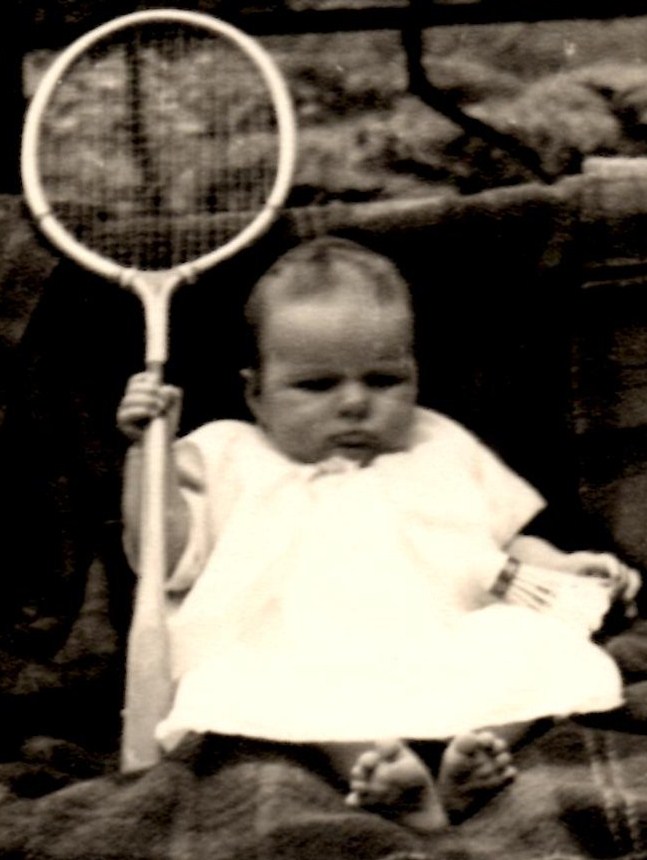
US OpenThe U.S. Open is getting underway today in Queens, NY, not far from where my New York daughter and her husband live, and the New York Times Magazine is awash in tennis talk and nostalgia, and so am I. I, the early tennis dropout.

Both my parents were avid tennis players, and my father tried valiantly to turn me into one as well. But I was skinny and pigeon-toed and claimed to be more interested in ballet. Until I became a dropout there as well. That was when I became interested instead in high school and being popular and having boyfriends. My poor father.

What I seem to remember most about tennis instruction from my father in the times we spent at the East Orange (NJ) Tennis Club is how to place your hands on the racket. What is that called? The handle, the arm? You see what a dropout I was: I can’t even remember the terminology. You were supposed to arrange your hand around that part of the racket with your fingers just so if you were going for a forehand shot, and then shift the position just so for a backhand shot. BOR-RR-RING!

And now Michael Steinberger is writing in the Times Magazine about the demise of the one-handed backhand. “The one-hander has become the last redoubt of artistry in tennis,” he writes, “a final vestige of the sport as it was traditionally played.”

I did wonder, in the years after his death, how my father would have reacted to the two-handed backhand being practiced at first by the likes of Jimmy Connors, Chris Evert and Bjorn Borg, and then later by nearly everyone, just as I similarly wondered what he would have said about the relaxation of the tennis whites dress code. And how about the shouting and displays of temper? Fortunately for him, my father died in 1970 and missed all the upheaval the sport endured, not to mention that in modern life in general.

But Ed and I are determined to make it into ripe old age so our children will witness all of our stumbles in geezerhood, embarrassing them and ourselves with our intransigence in the face of so-called progress. It’s so they won’t be surprised when their time comes.

But here’s something I gleaned from Steinberg’s article: “The fact that children’s rackets, like adult rackets, are significantly lighter these days suggests that it should be easier now to teach a 10-year-old to play with a one-handed backhand than it was 20 years ago. In addition, many children are being taught to play tennis using low-compression balls which are more conducive to rallying and perhaps more conducive to hitting backhands with just one hand.”

Squash playerThere you have it: I coulda been a star. Just born in the wrong time.

[Photo: Yes, I know that’s a squash racket, but my father had high hopes that I would become a multi-sports phenom.]

In the Pink? Never!

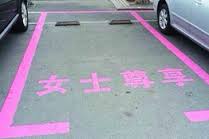
pink parkingA shopping mall in China has been accused of sexism after introducing special pink parking spaces just for women. The spaces at the World Metropolis Center in northeastern Dalian are about 11 inches wider than normal spaces and painted hot pink. Denying that the spaces insult women’s parking ability, mall officials said their larger spaces were designed “for practical purposes,” according to a report in the Shanghai Daily. “It doesn’t mean that women drive less well than men.”

Other cities in China have pink parking spaces, as does Seoul, South Korea, which has 5,000 spaces near the entrances to malls and other buildings. The explanation there is that they are provided as a convenience for women in high heels. The Korean spaces include a mini-skirted female figure as a graphic element. And in Germany, the city of Baden Wurttenberg mandates that at least 10 percent of parking spaces in large garages be for women; in Brandenburg it’s 30 percent. German officials say it’s to make women feel safer and less open to sexual assault.pink  parking 2

I am reminded of an incident soon after we’d moved to Los Angeles when I was rushing alone to church and hurriedly pulled into an unattended garage that is made available on Sunday mornings. As I turned into a space, the sound of a large crash reverberated through the garage and a man walking toward the exit spun his head around but then kept going. I got out of the car to inspect the bumper of the car I’d hit and then straightened my own car and locked up. At the corner, waiting for the traffic light to change, was the man from the garage and a woman I know. “Just so you know,” I told the man, “the other car was undamaged.” And then to the world in general I muttered, “I don’t know, ever since I moved here I have trouble with parking spaces.” “It’s because they are smaller,” the woman said.

If you think about it, parking garages in older cities – or in cities unlike Los Angeles with its old penchant for tearing down structures and building new ones – have spaces that were designed for older, bigger cars. Newer garages were designed with today’s smaller cars in mind. So I’m not a bad parker, just still living in the past, something that seems to come up more and more frequently these days.

Ed is the proud owner of a handicap tag, granted some years ago because of walking difficulties stemming from back problems. He will insist I drive all the way around a parking lot, passing several perfectly good spaces, to get to the handicap-designated one. It was only recently that he told me why. “These spaces are much roomier,” he said, “so there’s less danger of the driver next to you smashing his door into your car.”

Ah, so what we all need are wider parking spaces. Just please, don’t paint them pink.

[Photos: abcnews.go.com; news.kron4.com]