Let’s Hear It for the Egg

eggsIt’s almost Easter. Aren’t you glad that eggs have now been rehabilitated?

Also avocados, shrimp and other supposedly cholesterol-laden foods that nutritional experts have been warning us about for years. Cholesterol is no longer a “nutrient of concern,” according to an advisory panel. Chris Erskine, a funny writer I enjoy reading in the Los Angeles Times, wrote a tongue-in-cheek obituary a while back for the white-egg omelet, a gustatory abomination embraced by the health-obsessed.

In the same piece, Erskine also lamented the see-saw nature of our nutritional advice. ‘Decades of government warnings about fats and oils proved increasingly shaky,” he wrote. “After years of shunning butter, consumers were told that margarine was even worse, described by some as ‘chemical gunk.’ The findings on their morning coffee were even more confusing,” he continued. “One day coffee was good for you; the next day it was the worst thing since nuclear sludge.”

Similar uncertainty surrounds red wine and dark chocolate. Are these things good for you or not? Do you care? Or do you, like me, take most of these reports with a grain of salt? Oops, another bad thing.

The other day in Trader Joe’s, where we buy our house wine — the one that Ed and I drink when company’s not around – I thought I’d pick up the “20 slices of bacon” a recipe called for. Surrounded by all the earnest young shoppers filling their baskets with guaranteed healthful and non-chemically adulterated food products, I surveyed the bacon offerings. It was confusing and I walked back and forth several times reading the packages, all proclaiming “UNCURED! NO NITRATES OR NITRITES!” Okay, I thought, I guess I know nitrates and nitrites are not good, but isn’t meat supposed to be cured? Can bacon give you trichinosis? Maybe if I cook it a good long time it will be okay.

Life should be simpler. Food should be enjoyed, not obsessed over. Personally, I like to follow Oscar Wilde’s advice: “Everything in moderation, including moderation.”

Photo: commons.wikimedia

Do Not Feed the Baboons!

It’s the first of the month and as I turn the page on The Nature Conservancy’s wall calendar, I see them: three baboons. Just like the ones I did not see in South Africa. These guys, photographed in western Tanzania, appear to be working at opening some sort of shellfish from Lake Tanganyika, which the caption tells me is the world’s longest lake, holding “17 percent of our planet’s fresh water and (boasting) more than 300 fish species.” Lucky baboons.baboon in grass

At the Cape of Good Hope, which I visited with my cousin Dorothy, the warning signs were everywhere — “Baboons are Dangerous and Attracted by Food.” I’d seen similar signs atop Table Mountain towering 3,000 feet above Cape Town where we’d gone earlier in the week — traveling in a rotating gondola named The Flying Dutchman, me seated on a central perch, white-knuckled hands gripping a metal post and eyes tightly shut; I understand the view is magnificent.

Dorothy had told me of picnicking on the beach with her daughters when they lived in Cape Town and being watched by baboons hovering nearby. I was intrigued and wanted to see the animals myself. So everywhere we went in Table Mountain National Park, I kept hoping to catch a glimpse of a baboon and lamenting the fact that the closest I was coming to one was the ubiquitous signs. In the gift shop I even bought a refrigerator magnet that reads “Beware Baboons. Do Not Feed.” I guess I was being annoying, voicing my fear that I’d have to add baboons to my list of Animals I Never Saw in Africa because my cousin finally ducked into the gift shop and emerged with a small baboon figurine which she presented to me – “So you’ll finally shut up about baboons.”

South Africa 0052In the park flyer I read that baboons on the Cape Peninsula are protected, the only ones with that designation in all of Africa. You are warned to keep a safe distance from the animals, move away slowly if one approaches you, and hide your food. Feeding a baboon will get you fined. All of this information proved to be moot as I never did see one. And I thought I never had seen one anywhere ever until my daughter remembered that baboons had swarmed over our car as we drove through a wild animal park in New Jersey many years ago, defecating all over the car windshield. That memory removed any intrigue that might have existed before.

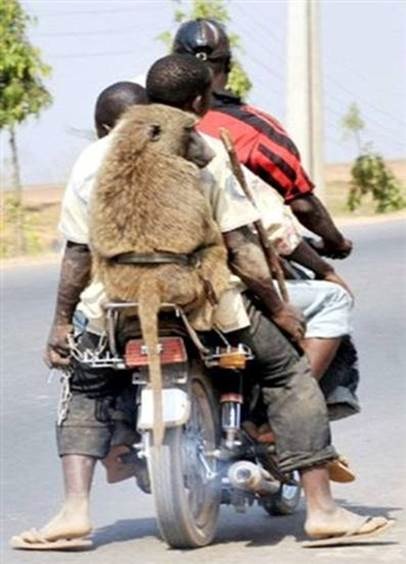
Dorothy confirmed that baboons are not very nice animals. But then this picture showed up in my e-mail. Go figure.

baboon on a bike

I Miss Snow

The weather out there in much of the country is frightful, but I’m sorry to report that here in Southern California it’s pretty darn delightful. Don’t hate me for it because, truth be told, I miss snow. Maybe not in the record-breaking amounts being experienced this year (still think climate change is a hoax?) but some.

Our New York daughter, while dreading the coming next onslaught, sends us video from her apartment window of the initial snowflakes. I voice my sympathy for the struggles that will ensue but can’t help mentioning how beautiful the scene is. Likewise, with the photo a friend sends from Providence showing a frozen river not too far from her front door. It’s so beautiful!Providence River

But Boston — good grief, poor Boston –– has run out of places to stack the snow. Trucking it to outlying fields and considering various water bodies in which to dump the stuff.

I try not to mention that the weather here is balmy, in the 80s with just the hint of a soft breeze or that the jasmine by the front door is beginning to bloom, sending its intoxicating aroma throughout the house. And I know they won’t believe me when I say that I miss snow.

I miss the hush that comes over a neighborhood when snow covers the landscape and before the snowplows and snow blowers get to work. And even afterwards, if you’re lucky enough to score a snow day, the forced confinement that feels like a particularly special gift, a time to read a book or watch a movie – or even to tackle some long-avoided project like organizing family photographs or sewing buttons on an old sweater that is down to just two.

Ed does not share my nostalgia for snow. He grew up in Colorado and doesn’t care if he never sees another flake. And he’s fond of saying that the best part of the house sale when we were moving from New Jersey was watching the snow shovel walk out the door.

(And speaking of my much-maligned home state, I have been trying to come up with a way to share Buzzfeed’s 22 Reasons Why You Should Never Visit New Jersey. It includes photos of snow but a great deal more. Showing it here is a stretch, I know, but something to look at it if you’re snowed in.)

So how’s this for an idea? Instead of building a pipeline to transport tar sands oil from Canada down to the Gulf region, why not a pipeline going across the country from east to west to transport snow from the beleaguered snowbound regions to the parched western states. They’d have to find a way to filter out the street pollution that’s mixed up in all that snow but hey, this is America. Didn’t we used to be a can-do nation? Let’s put our minds to it.

In the meantime, enjoy your snow day. Unlike you, I have to work in the yard.

Lost in Conflation

brian williamsPoor Brian Williams. The NBC newsman is being pummeled for having said he was aboard a military helicopter when it was shot down in Iraq in 2003. He has apologized, saying he had been in a different helicopter, behind the one that had been fired upon and, as The New York Times reported, had inadvertently “conflated” the two. The paper wrote, “The explanation earned him not only widespread criticism on radio and TV talk shows, but widespread ridicule on Twitter, under the hashtag ‘#BrianWilliamsMisremembers.’

Similarly, Hilary Clinton was ridiculed after she acknowledged having “misspoken” when she described running across a tarmac to avoid sniper fire upon landing in Bosnia when she was first lady in 1996.hilary clinton

I like Brian Williams and not just because he grew up in New Jersey as I did. And I like Hilary Clinton. I sympathize with both of them for finding themselves lost in conflation. I understand how it can happen. You’re close by a scary event, you realize it could have been you experiencing it and not the people who actually did experience it, and over time you internalize the details so that it becomes, in your mind, something that really happened to you. That’s not the same as lying. As a public figure, you’d have to know that other people were there, and if you were lying, they’d know it. Why would you put yourself in that position?

After more than half a century together, Ed and I share many stories of things we experienced jointly. Frequently, he “misremembers” the details of one event or another. Sometimes I correct him and sometimes I let it go. What difference does it make? And I’m sure he does the same with me when I “misremember” things.

The difference with Brian Williams and Hilary Clinton and other public figures is just that: They are public figures. And they have staffs. Were their staff members so cowed that one could not have taken the boss aside and pointed out the “misremembering” before it became fodder for late night comics?

The last time we were together with both our daughters and their husbands, our older daughter told a story of how she had been destined to be left-handed but that I, being left-handed myself, was determined to try to prevent that, placing items in her right hand and not the left. I had to tell that daughter that that story was not hers; it was her sister’s. I did indeed try to encourage both daughters to have an easier time in life by being right-handed. And the older daughter went along with it. But every time I placed an item in her younger sister’s hand, she’d move it to her left. After many months of this, I gave up. But the older daughter, having heard that story her entire life, had conflated it to be about her. No big deal; it happens. “I’m sorry,” I told that daughter, “but I was there and that’s what I remember.”

But who knows. Maybe I’m the one who “misremembered.”

This Epidemic Didn’t Need to Happen

“Disheartening” was the word used by the Orange County health officer to describe the fact that a disease that had been all but eliminated in the United States in 2000 is now the cause of an epidemic spreading from Southern California to several other states across the country and into Mexico. NPR’s Melissa Block had asked Dr. Eric Handler his reaction to the situation that had its start before Christmas at Disneyland, carried by one unvaccinated tourist and spread rapidly among several native-born citizens who had not been vaccinated. The highly contagious disease is one that we tended to lump together in our minds with all those childhood ailments that, one by one, were brought under control by the development of a vaccine.

As a young mother, I remember marveling that our children could be protected from diseases that we suffered through in our own childhoods: whooping cough, measles, rubella (German measles), mumps. Once the disease had passed you were pretty much assured of having natural immunity. (My younger brother came down with chicken pox and we both were quarantined, a bold sign on the front door warning others away. I was spared and years later, when both my children had the disease, I cared for them and was again not affected. So when a physician suggested I go for a newly developed anti-shingles vaccine for anyone who’d ever had chicken pox, I could happily decline.)

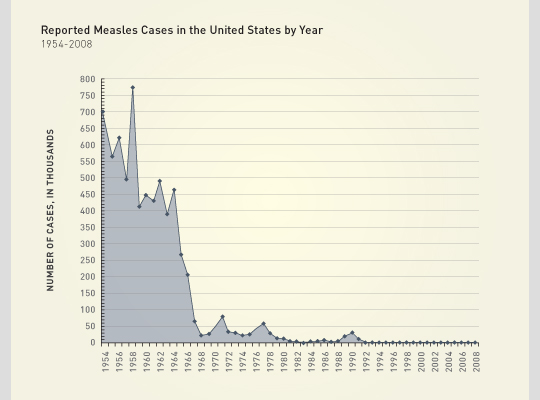
An earlier NPR report noted that anyone born before 1959 is protected from the current measles epidemic because it would be assumed they’d had the disease as children and carried natural immunity. Before the vaccine was introduced in 1963, the U.S. experienced some four million reported cases a year. In 2000 the number was zero.

And now it’s back. Even before the current epidemic, the CDC reported that 2014 saw a record number of cases — 644 from 27 states. The reason is a growing anti-vaccination movement that finds parents opting out of vaccinations for their children based on fears resulting from a report, since discredited, of a link between inoculations and autism. Major scientific organizations all refute the claims. Now, a generation of doctors who have never seen measles is frantically trying to catch up on the symptoms and treatment of the disease. Untreated or treated late, measles can lead to serious complications, even death.

Measles graphA strongly worded editorial in The Los Angeles Times calls for an end to the practice of allowing parents to opt-out of immunizations requirements for their school-age children on the basis of “personal beliefs.” The outbreak has illustrated “how a highly contagious disease can spread when the vaccination rate falls below the level needed for ‘herd immunity,’” the paper wrote, explaining that herd immunity means “that so many people are immune that the chance of outbreak is low, which protects the few who are not immunized because they are too young to have been fully vaccinated or because they are among the few in whom the vaccine doesn’t ‘take’ or because they haven’t been vaccinated for valid medical reasons.”

As the paper stated in another editorial, “Getting vaccinated is good for the health of the inoculated person and also part of one’s public responsibility to help protect the health of others.”

Once again, we must be reminded that we’re all in this together, folks.

Graph: U.S. Centers for Disease Control & Prevention

Remembering Newark

My cousin sent an article from The Guardian describing changes taking place in Newark, New Jersey’s largest city and the last place many people would expect to ever see gentrification. While a third of the city’s population lives below the poverty line, business is booming in downtown Newark and New Yorkers priced out of their city’s housing costs are eying the neighboring city 10 miles to the west. Xan Broooks, the article’s author, repeats a quote from former Newark Mayor Kenneth Gibson: “Wherever American cities are going, Newark will get there first.”

Dorothy grew up in Newark and my family’s home was in the nearby city of East Orange. (At college in the Midwest, my 220px-East_Orange_City_Hall_Lincoln_jehhometown’s name drew snickers and comments like “East Orange. Is that anywhere near West Lemon? Yuk, yuk.” Of course, here in Southern California I get none of that since a great many place names pay homage to assorted varieties of citrus. New Jersey’s Oranges – Orange, East Orange, West Orange and South Orange – reflect this country’s original status as England’s colony and acknowledge such people as “William of …”).

Essex County (another nod to England) was a wonderful place for a childhood with parks and playgrounds, safe tree-lined streets with sidewalks, and excellent schools. My old elementary school, Franklin School, now The Whitney E. Houston Academy of Creative and Performing Arts, sat across the street from a branch library and a big expanse of green parkland with a brook running through. Not exactly the picture many people have when they think of New Jersey. Whitney Houston was one of many famous people who have called East Orange home – and many still do.

Whitney Houston SchoolEast Orange was a city and Newark was the bigger city close by where we dressed up to ride the bus for back-to-school shopping and lunch at Schrafft’s. Newark was where I went for ballet classes, riding the bus downtown by myself and walking over to my father’s office and then with him to the Margit Tarasoff School of Russian Ballet, where Mme. Tarasoff taught classes and where occasionally her husband Ivan appeared. Then bent and walking with a cane, he had been a star dancer in Russia. When he appeared in the studio to observe (and critique), we students were terrified. Mme.Tarasoff, born Margit Leeras I learned years later (thank you, internet), had been a ballet star in her native Norway.

As for the really big city of New York, that was where we went on special occasions, say to attend the Christmas Show at Radio City Music Hall and, maybe once, to see the Macy’s Thanksgiving Parade, or to eat at the Automat, that deliriously child-friendly restaurant with individual dishes of food behind glass doors that opened when the requisite numbers of coins were inserted and the handle turned. So much more fun than a cafeteria.

And these are just a few of the memories The Guardian article generated for me. I wish Newark well in its upward climb. But I hope it will be able to accomplish that without leaving its longtime residents behind in gentrification’s dust.

default_thumbPhotos: East Orange City Hall; Whitney E. Houston Academy of Creative & Performing Arts, East Orange;New Jersey Performing Arts Center, Newark

Drought. Really?

after stormDriving home, I heard the ping indicating a text message, and when I pulled up to the stoplight, read from a friend on the East Coast: “Wondering if you are safe and sound. The storms in LA are scary!” I pointed my phone straight ahead and sent her this picture. “What a beautiful day!” she wrote back.

And it was, at that point. The sky looked almost celestial. All that was missing was a trumpeting angel or two.

When I got home I wrote my friend that yes, at times the storm was scary. During the night before, the roaring winds and sheets of rain woke us. Our Great Dane Lotte — who, unlike all eight of her predecessors, never gets on the furniture – climbed up in bed with us. The next day gave us a cornucopia of weather patterns: rain, sunshine, more rain, more sunshine, dark menacing clouds, clear blue skies with puffy white clouds hanging over the mountaintops. California weather is nothing if not dramatic.

But we’re in a drought and will continue so for a long time, say government officials and water professionals, a fact that Los Angeles Times political columnist George Skelton finds annoying. “Highways have closed because of flooding. Cars have been hydroplaning and been swept off roads. Creeks are leaping their banks. The Los Angeles River has become a real river. That’s hardly a drought,” he wrote.

He chided officials for their doomsday talk and urged them to come up with a better definition for the current situation. “How about simply calling it a water shortage?” he wrote. He also challenged them to start moving on worthwhile projects to avoid future drought conditions. The voters approved a $7.5 billion water bond but, he’s told, it will take at least three years for projects to be selected and construction begun.

This drought thing has been going on for many years, and most people are doing their best to not waste water. It’s about time that politicians and special interest groups stop just talking about drought and start doing something about it.

USPS, You’re Losing Me

USPSIn spite of everything, I’ve always been a defender of the United States Postal Service. When a conservative Congress forced them to sock away an inordinately large and unnecessary amount into their pension fund in an effort to drive them into insolvency, I was sympathetic. When they faced opposition in their money-saving proposal to end Saturday delivery, I was supportive. (I have no problem receiving Saturday’s stack of junk mail on Monday.) And when anti-union people rail about generous benefits accruing to postal workers, I remind them “neither snow nor rain nor heat nor gloom of night…” the unofficial creed of the Constitution-mandated postal service.

And how has this loyalty been rewarded? Let me tell you.

My husband is fighting a serious illness, something we wrote about in last year’s Christmas letter, so he wanted this year’s letter to go out early to assure friends and relatives that he is not dead. We purchased the paper and envelopes in the summer and wrote the letter immediately after Thanksgiving. In the first week of December, I delivered 171 stamped letters to the post office (yes, it’s a large mailing list). The next day, a dozen or more were delivered to our own mailbox. I stormed down to the post office with the stack in hand, ready to do battle, but the clerk in the nicest possible way told me the mistake was mine: I never should have put my return address on the envelope’s back flap even though there was a specially designated area there for just that sort of thing. “I always tell people not to do that because it confuses the machine,” she said.

She added that I would not have to pay for the postage and then grabbed a marker and drew big black lines across the machine’s printing on the front and back of each envelope before tossing them into a box for re-delivery. I shuddered at the desecration inflicted on an envelope printed with doves of peace and told myself to live with it. The next day, one more letter came back to us. That one I made a new envelope for.

Having never been in the inner recesses of any post office, I have no idea of the procedures once the mail leaves my hands. Are there robots back there, feeding mail into machines? Are some of the workers visually impaired, a good thing for the post office to do just not in that particular job. And what about the delivery person, a nice friendly guy who is frequently replaced by strangers? Did nobody notice something odd about envelopes with stamps on one side and an address on the reverse? I tried to put it all out of my mind.

Until I began to wonder about the others. Were people receiving them or are stacks sitting in some postal facility in Tennessee? I have begun asking people if they’ve received the letter, something I’d rather not do as it puts them on the spot. Perhaps they looked at the envelope and thought, “Oh God, here’s that awful letter she always sends. I’ll read it after the holidays, if at all.” Our New York daughter said, “I don’t know. It could be here in this pile of mail I haven’t had time to look at.” Our Los Angeles daughter said, “No, we didn’t get it and I wondered why.”

So now I’ll spend the entire holiday season waiting for a giant stack of letters to come back to us, maybe in February. Thanks a lot, postal service.

Another Tradition Bites the Dust

“Oh no, you don’t write one of those awful things, do you?” The woman and I were discussing the approaching holiday season and enumerating the various chores each of us faced. I admitted I did indeed send out an annual Christmas letter and had been doing so for years. However, to myself and somewhat petulantly I thought, “I do try hard to make mine not awful.”

But let’s face it: Love ‘em or hate ‘em, Christmas letters are on their way out. One more tradition supplanted by the internet. If you’re on Facebook or one of the other social media sites, your friends and family have a continual barrage of news coming at them about wonderful you. An annual recap would just be redundant.

I, on the other hand, don’t participate in those things. It’s all I can do to wade through the email each day, deleting sales pitches from every outfit I ever did the smallest bit of business with – and many I’ve never before heard of – hoping in the process that nothing important gets overlooked and that friends understand when I don’t comment on every item they send my way. Wasn’t the digital age supposed to make life easier?

So I send a Christmas letter. As I explained in a post a year ago, the tradition began because our family was, from the start, far-flung. Five cross-country moves and a proliferation of different jobs have swelled the list of people we hope to stay at least nominally in touch with. This is the way we chose to do it.

The letters, beginning in 1973 and with some unexplained gaps, provide a running commentary on our little nuclear family and the times in which we lived. And, hoarder that I am, I’m loath to throw them away. That is why I’ve started to assemble them here on this website for others to read ̶ or not as they wish. It’s definitely a work in progress with just two letters up so far. There’s the one from 1973, written on a typewriter with a key that broke in mid-composition, and this year’s, which was produced on a computer and printed on glitzy holiday paper. More will follow.

Abbondanza? Of Course!

In anticipation of Thanksgiving, The New York Times printed a state-by-state rundown of favorite dishes that might grace those holiday tables. As a half-Italian person who grew up in New Jersey, I was glad to see the entry for that state included baked manicotti. The writer of that piece states, “For many Italian-American families, in New Jersey and elsewhere, the Thanksgiving smorgasbord doesn’t feel quite right without a little touch of red sauce.”

Thanksgiving, Jeff Gordinier points out, “also represents an American expression of abbondanza, the Italian concept of too-muchness that makes a meal feel epic.”

The manicotti recipe sounds lovely, made as it is with crepes rather than pasta to make it lighter and less filling. I will try it sometime. But not at Thanksgiving. My family’s tradition calls for lasagne, made in as close an approximation as possible to my grandmother’s, and served as a first course prelude to everything else.

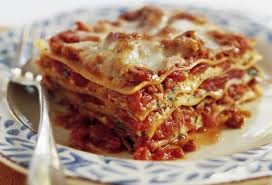
lasagneIf you happened to drop in to my grandparents’ house in the days preceding any major holiday, you’d find Grandpa spreading sheets of paper over the high back wooden chairs that would then be covered with strips of pasta dough that he took from Grandma as she finished making them. The fresh dough would be allowed to dry and then be assembled into layers with cheese (ricotta, mozzarella and parmesan) and homemade tomato sauce. When the day of the dinner arrived, the oversized iron stove fairly glowed, filling the house with an assortment of delectable aromas. Once everyone was seated at the long dining room table, the baked lasagne was brought in and placed before Grandpa who cut the first square and declared it “a perfect brick,” just the right consistency of layered pasta, cheese and sauce.

Grandma’s lasagne was incomparably delicious, and unsuspecting newcomers to the holiday table gladly accepted offers of second helpings. Then, to their dismay, came the rest of the meal: the meat (which type dependent on the holiday), potatoes, vegetables, assorted relishes, bread and finally, a simple lettuce salad dressed with oil and lemon juice. Dessert was also fairly simple because cake would be served later at a follow-up supper.

Ed and I have continued the lasagne tradition at all our holiday dinners. It came in handy when increasingly more diners were vegetarians; you knew they wouldn’t go hungry if they passed  on the turkey, roast beef or ham. But I’ve never been able to figure out how Grandma managed to put together the follow-up supper, even though it consisted of little more than sliced meat and cheese, bread and crackers – and cake. One gargantuan meal is the most we can pull off in a day.

[Photo: mondoricette.forumfree.it]