Good for You, Justice Ginsburg!

Sexism even on the Supreme Court? Why am I not surprised?  Justice Ginsburg

In a New York Times article by Adam Liptak, Justice Ruth Bader Ginsburg is shown comparing differences in the court’s rulings on gay rights cases with those involving gender. The gay rights rulings are replete with soaring language about “equal dignity” and endorse values of “liberty and equality,” while those dealing with gender issues seem to indicate that the court has not fully embraced, in her words, “the ability of women to decide for themselves what their destiny will be.” She noted, Liptak writes, that “the court’s five-justice conservative majority, all men, did not understand the challenges women face in achieving authentic equality.”

Those challenges are ones that have dogged the 81-year-old Ginsburg her entire life, from attending Harvard Law School as one of nine women in a class of more than 500 to graduating from Columbia Law School and being denied jobs with law firms or judicial clerkships because she was a woman. As a professor at Rutgers School of Law she was informed her pay would be less than her male colleagues because her husband, also a lawyer, had a good job.

Before becoming a judge, Ginsburg was a prominent women’s rights attorney, and yet, on the Supreme Court, Liptak writes, she “has suggested that her male colleagues sometimes do not hear a woman’s voice, including her own. In a 2009 interview with USA Today, she said the other justices, who were then all men, sometimes ignored the arguments she made at their private conferences.” She would say something but it would not be focused on until someone else said the same thing.

It’s been a lot less lonely for the justice now with the addition of Justices Sonia Sotomayor and Elena Kagan, but their inclusion has not kept the court from delivering devastating setbacks in cases involving equal pay, medical leave, abortion and contraception, culminating, as the Times article points out, “in a furious dissent last month from the court’s three female members.”

Some liberals are urging Justice Ginsburg to retire so President Obama can appoint her replacement before his term ends, thus assuring that a liberal voice will not be lost. But the justice says she has no intention of doing so as long as her health and intellect remain strong. And good for her.  It’s supposed to be a lifetime appointment after all, so quit trying to push her out. Instead, perhaps those people should direct their efforts toward assuring that the one who will be doing the appointing shares the same philosophy. Imagine what a liberal majority could accomplish.

Photo: en.wikipedia.org

The Secret Word Is Banana

I flunked the short-term memory test today at the doctor’s office. “Here are three words: banana, sunrise, chair,” said the nurse. “What are the three words?” “Banana, sunrise, chair,” I repeated proudly. Many questions and unrelated conversations later, she handed me a piece of paper. “Write those three words I gave you earlier,” she said. All I could remember was banana, probably because I’d had nothing to eat, it being lab tests that required fasting. “Hey,” I protested, I thought I no longer needed those words so I sloughed them off. That’s what we old people do.”

Another new wrinkle (no pun intended) in the aging process is that one’s annual physical now includes psychological questioning to determine whether the person is depressed, suicidal, drinking too much, losing sleep and a lot of other things including becoming more forgetful.

For one of today’s tests, the nurse asked me to draw the face of a clock and to indicate the time of 11:10. I was proud of the fact that I started with the 12, 3, 6 and 9 and then filled in the other numbers. Shows I recognize spacial distances, I thought. When I got home I happened to glance at a clock. Oh, my gosh, I’d mixed up the hands, showing the time as 1:55. Sure hope she remembers my mentioning I am left-handed. We left-handers frequently get things backwards.

I don’t mean to make light of these kinds of tests. We are all terrified of developing dementia or Alzheimers, its most common form, accounting for 60 to 80 percent of cases. According to the Alzheimer’s Association, the disease “is not a normal part of aging, although the greatest known risk factor is increasing age, and the majority of people with Alzheimer’s are 65 and older.” But, the Association’s literature continues, “up to five percent of people with the disease have early onset Alzheimer’s which often appears when someone is in their 40s or 50s.”

So what to do? A person I know gives himself daily mental exercises through luminosity.com. Others play Words with Friends online or do crosswords and word puzzles. My hope lies with two daily newspapers and a bunch of magazines, along with constant book-reading. It is scary to imagine what it must be like to be aware of your mind slowly fading away.

I joked a lot during today’s testing and made the nurse laugh several times. Next time I’ll take it more seriously. The joking older people do about memory loss is akin to whistling past the graveyard. Which is another thing we’re good at.

Idle Thoughts over the Ironing Board

iron-clip-art_419552What!? You still iron? No one irons anymore.

Yes, I’ve observed that. But to my mind, with the exception of seersucker, there’s hardly any fabric that can’t be made to look better with the ministrations of a warm iron or a burst of steam.

To the idle thoughts. Which do you suppose came first: women’s clothing manufacturers skimping on fabric to make short sleeves that are too short or women half-killing themselves in daily exercising to tone their upper arms so as to accommodate the too-short sleeves? And don’t blame Michelle Obama, she of the super-toned arms. She is just a product of her times, what I like to think of as the fitness obsessed generation.

As someone who hasn’t shown her own upper arms in public in decades, I find it all very distressing. I watch women newscasters on TV, their arms bared through all seasons, and it makes me feel personally cold, even more so in winter. Do the studio lights keep those women from breaking out in goose bumps? I’m grateful to Rachel Maddow who continues to show up in a suit jacket atop the jeans that you know are hidden from camera range.

And speaking of cold, how about restaurants? In most, the cold air blasts right along with the music, and people of a certain age huddle in their booths, swaddled in shawls and cardigans pretending they can hear enough to follow the conversation.

Here in Los Angeles, this city built atop a desert, the temperature plummets once the sun goes down. So I am frequently cold. I keep waiting for my East Coast body to acclimate to West Coast temperatures but it doesn’t appear it’s going to happen. Our mailman wears shorts year-round and people live in flip-flops if they’re wearing anything on their feet at all. A young man in the pew ahead of me in church one day was barefooted. At one point he began standing on one foot, with the other foot resting, sole up, on the seat. I stared at the bottom of his foot which was understandably not clean.

In the wintertime, when daytime temperatures hover in the high-50s and low-60s, I’ll be driving around sometimes wearing two sweaters and a jacket. On the street, I’ll see people in tank tops and shorts. It takes all my self-control not to open the window and shout, “Put some clothes on before you catch your death!”

But this is summertime with the state of undress even more exaggerated. People deal with the drought and wish for rain. And I find my idle thoughts moving in other directions. Like: Do you suppose there is a job description for the person who assures that more than one tissue at a time emerges from the box? Or the one who makes sure that the tube of sunblock dispenses far more product than one needs to protect those over-exposed limbs? Just thinking.

He Did Not Die on the Fourth of July

July 4 (2)It’s July 4th and I’m feeling nostalgic for Independence Days past. Montclair, New Jersey did a fine job with the holiday, beginning with a parade of marching bands and representatives of various organizations in town. The parade was heralded every time first by the appearance of antique cars (“You know you’re getting old when the cars in the parade are identical to ones you went out in on dates,” I always said.) If you were lucky and knew a friend on the parade route, you could stand on their porch eating bagels and drinking Bloody Marys while watching the parade. Later in the evening there was a big fireworks display on the high school’s football field.

I’m sure there are wonderful parties here in Los Angeles this year, parties on boats, in fabulous homes on the beach, but we are babysitting two grand-dogs and one grand-cat. So lots of time for nostalgia.

Back in Montclair, the festivities presented a large gap of downtime in the afternoon – more than enough to sleep off the Bloody Marys – and then what? That is why Ed and I began hosting a party at our house. We provided hot dogs and hamburgers, along with cheap beer and wine, while the guests brought everything else. (“What do you need me to bring?” “Anything.” “But don’t you worry there’ll be nothing but potato salad?” “Never happens.”)July 4th food

One year, after one such party, the guests all hurried off to the fireworks and we stayed behind cleaning up. As we walked back and forth through the screen door, an insect began buzzing against the screen and the cat batted at it from inside. On one of his trips through the door, Ed suddenly felt a sharp sting on his arm. “Ow!” he said. “That hurts.” In a short time he said, “You know, I feel strange.” “How strange?” I asked. “I don’t know, kind of light-headed.”

Being in a mellow mood after the day’s activities, I suggested we go to the hospital.” “That’s silly,” he said. “It’s just a sting.” “Oh, c’mon,” I persisted. “Let’s just go there.” As we drove, I asked him about symptoms, information I’d picked up from my own experience with yellow jackets. “Are you feeling warm? Short of breath? Is your throat closing?” When he answered yes, I began running red lights and screeched up near the hospital’s emergency entrance. But I’d parked too far back. “We’ll just have to walk the rest of the way,” I told him.  His walking became slower and slower. “C’mon,” I urged. “Can’t you go any faster?”

The security guard noticed and came with a wheelchair. “I’ll bring him,” he said. “You go ahead and sign him in.” While I was answering questions and filling out forms, the guard arrived with the wheelchair and Ed who promptly passed out. “Oh my God!” I screamed. “Do something!” The receptionist picked up the phone, the emergency room door flew open and a team of doctors and nurses whisked him away. I went back to the paperwork and then, as instructed, went to sit in the waiting room.

After what seemed a very long while, a doctor appeared and sat beside me. “Well,” he said, “we almost lost him but he’s going to be okay.” “You almost what??!” I said. “He got stung by a bug.” “Yes,” the doctor replied, “and it put him into anaphylactic shock. “His heart stopped and his pulse rate went to nearly zero.” Later Ed said he remembered hearing a voice say, “That’s it. This guy’s out of here.” But other voices urged him to “hang in there, you can make it.” We later learned that hearing is the last sense to go.

hornet 2After an overnight stay in intensive care, Ed was released with prescriptions, including one for a kit of medications to carry in case of another attack, and shortly signed up for desensitizing allergy shots. And we both got educated about insect stings. Ed’s attacker was a white-faced hornet, also called a bald-faced hornet, a particular nasty variety, made all the nastier by the tormenting cat. While not the first insect sting of Ed’s life, we learned the venom’s intensity can build up in a body over time. We also learned that many deaths attributed to heart attacks could very possibly have resulted from insect stings. A person working alone in his garden, ignoring a sting, could die there without anyone knowing the real reason.

What I have never been able to reconcile in my mind is what kept me from saying to Ed that night,  “Oh, why don’t you just go lie down and see how you feel later?”

Photos: huffingtonpost.com; bioweb.uwlax.edu

When Did My Elbows Get Old?

world cupThe World Cup is under way in Brazil, and even if you have minimal interest in soccer – or football as the rest of the world calls it – information seeps into your consciousness. For example, I am now thinking about Brazil, a country I’ve never visited, and Brazilians, people whose paths have crossed with mine over the years. I know they, like many in South America, are known to place a premium on beauty, especially female beauty. Brazil is one of many Latin American countries that stage a lot of beauty pageants throughout the year. In fact, Brazil has Las Gatas do Paulistäo, a contest to find the best looking female soccer fan in the country.

One time, a man told me of his visit to his wife’s family in Brazil and a conversation he’d had with a group of local men. There are three ways you can tell how old a woman is, he was told: Check out her neck, her hands and her elbows. I know about the neck. Just as Nora Ephron’s hilarious book I Feel Bad About My Neck pointed out, no amount of skin cream and sunblock can stop the neck’s downward slide into wrinkledom. You can try to hide things with a cleverly tied scarf if you’re handy that way or a turtleneck if you can stand the itching. But eventually, you need to give in: This is what my neck looks like, you’ll tell yourself.

As for the hands, they’re a lost cause unless you want to spend the rest of your life indoors, hands perpetually encased in gloves. Someone told me the juice from an aloe plant will remove brown spots on the hands caused by the sun. So I planted one on the deck but have yet to try it. Sounds sticky. And yes, I know sunblock will prevent the spots but how many times a day are you willing to reapply the stuff that gets washed or sweated away? So again, these are my hands; they are hands that work.

lemonBut elbows? How funny. It conjures up images of a guy sidling up alongside a woman and angling his head in a way to glimpse an elbow. I have a dim memory of a pre-teen me reading in a magazine the benefits of rubbing one’s elbows with a lemon half – or two halves, one for each elbow, and doing it. I no longer remember the benefits of the procedure and besides, at SEVENTY-NINE CENTS EACH in the supermarket this summer, there are better things to do with a lemon. Think gin and tonic.

Our cleaning woman back east was from Brazil and would periodically return home to visit family and have plastic surgery. She was a very pretty woman about my same age and the flaws she thought needed fixing were, to my eye, infinitesimal. But their eradication was important to her. When the World Cup was on and Brazil was playing, she’d move from room to room to clean, turning on the nearest television to follow the game and occasionally, when things got interesting, just sit down transfixed. I wished I could be that enthralled with the sport or, in fact, with any sport.

To my mind the best thing about international sports competitions is all the extraneous information that comes across in the commentary provided during down times. One couple I know became so taken during the last World Cup with what they learned about the country of Uruguay they’ve planned a trip there during this year’s event. They’ll get to see the country and also witness reactions of soccer fans with considerably more interest than exhibited by most people here. Someone else told me they could get the same thing by leaning out the window in Queens. But I don’t suppose it would be altogether as satisfying.

world cup 2

[Photos: wikipedia.org; commons.wikimedia.org;bbc.com]

Bunnies and Fishes and People, Oh My!

It’s bad enough that I cannot open a jar of face cream without wondering if baby bunnies were harmed in the product’s testing. Now I also have to worry about fish ingesting plastic microbeads that rinse off my face and on down the drain and eventually into the waterways. And while we’re at it, what about people eating the microbead-filled fish. Microbeads also absorb toxins. None of that can possibly be good, can it?

microbeads 1The issue of microbeads is in the news lately.  They’ve been added to face cleansing products and shampoos and the like. Now, I’m all for exfoliating dead skin cells, which is what the beads are supposed to do. But I can’t help wondering: Aren’t there other ingredients that could achieve the same thing? Yes there are, says 5 Gyres, an environmental organization conducting a campaign to encourage manufacturers of personal care products to replace microbeads with alternatives like crushed walnut husks and apricot kernels that degrade naturally.

Several manufacturers have agreed to start voluntarily phasing out the use of microbeads, and some states like New York have passed legislation banning their use. In California, such a bill has passed in the Assembly and is headed for the Senate. In the meantime, a smartphone app has been developed that enables consumers to scan products to see if they contain microbeads.

This is all well and good. But I can’t help wondering why it never occurred to manufacturers that microbeads in products designed to be washed down the drain was a bad idea. I imagine a conversation in a corporate office where the researchers are filling in the managers.

 “We have a wonderful new product for you to introduce. It contains microbeads.”

“Really? What’s a microbead”

“A revolutionary advance in body cleansing.”

“Oh, what’s it made of?”

“Plastic.”

220px-Nasa_blue_marbleAt this point was there no one in the room to suggest that the one thing the world’s waters did not need was more plastic? Why do we wait until a product is out in the marketplace before it occurs to anyone to question its desirability?

We seem in such a frantic rush to destroy our planet, the thing described in an Episcopal Church prayer as “this fragile earth, our island home.” It is disheartening.

[Photos: 5gyres.org, NASA]

Flight School

Neil_Armstrong_family_memorial_service_(201208310007HQ)It’s Memorial Day and the planes are flying high above in the four-square formation commonly called the “missing man flyby.”  At some point, one plane will peel away, representing comrades lost in war.

Meanwhile, a baby crow has crash landed in Eloisa and Martin’s flower-filled garden in what was possibly its maiden flight. Overhead on a utility pole, two adult crows are squawking their consternation. Martin says Eloisa has concocted a narrative elaborate enough for a full-length movie script. She says she’ll keep an eye on the situation and if the parents aren’t able to rescue the baby, she knows of an organization she can call for help. I decide the best I can do for the crows is to move my dog and myself along.

caterpillar-chrysalis-adultTo tell you how much of a naturalist Eloisa is you should know that she routinely plants ordinary-looking milkweed among her riotous profusion of flowers so the monarch butterflies will have something to eat when they emerge from their chrysalis on their northward migration. And if one cryssalis should fall to the ground prematurely, Eloisa will lift it gently up onto a ledge so it can safely continue its gestation. One early morning, spotting an orange and black monarch in her garden, I was so excited I thought of knocking on the door to tell them but I decided they probably already knew it was there. Walking past Eloisa and Martin’s house can turn into a science lesson and teach you things you never knew you wanted to know.


Photos: wikipedia.org, mmonarch-butterly.com

Fun at Work

My Uncle Bill, who worked forty years at a job he didn’t much like and who resented the gold watch he received upon retirement because it was self-winding (“What a stupid thing to give someone who was retiring!” he’d say when the watch kept running down because he was insufficiently active.) I once inspired my uncle’s ire when I suggested that Ed and I, beneficiaries of America’s Golden Age of employment, would quit our jobs if ever they stopped being fun. “You are such a jerk!” he fumed. “Jobs are jobs. They’re not supposed to be fun.”

(Some might dispute my description of a Golden Age of Employment. People sometimes did lose their jobs, but their unemployment didn’t stretch into years as can happen now. And you never heard stories of an employee, innocent of any crime or infraction, returning from lunch to find a security guard with a cardboard box for the employee’s personal effects prepared to provide an escort out of the building.)

I remembered that interchange with my uncle when I read Gordon Marino’s piece in Sunday’s New York Times, “A Life Beyond ‘Do What You Love.’”  He wonders whether “do what you love” is actually “wisdom or malarkey.” He refers to an article in Jacobin magazine earlier this year in which the writer Miya Tokumitsu suggested that “the ‘do what you love’ ethos so ubiquitous in our culture is in fact elitist because it downgrades work that is not done from love.”

Elitist, huh? That cut close. Maybe Uncle Bill was right to slap me down for my comment, coming as it did with the benefit of a college degree awarded during a period of economic growth and prosperity. Compared to the prospects today’s graduates are facing, we were indeed a lucky generation, able to pick and choose – and abandon – jobs as we saw fit. Uncle Bill of course came out of the Great Depression and remembered when jobs were precious and worth hanging onto for dear life. Never mind “fun.” Will today’s young people, touched by what I call The Never-Ending Great Recession, feel the same way? Will they be allowed to indulge in today’s buzzword, “self-fulfillment”?

His own father, Marino writes, labored at a job he detested so he could send his children to college. “Was he just unenlightened and mistaken to put the well-being of others above his own personal interests?” he asks. “It might be argued that his idea of self-fulfillment was taking care of his family, but again, like so many other less than fortunate ones, he hated his work but gritted his teeth and did it well. It could, I suppose, be argued,” Marino continued, “that my father turned necessity into a virtue, or that taking the best care you can of your family is really a form of self-service.”

My mistake in that interchange with my uncle was in using the word “fun.” A creative effort of any kind can be fun. Finding a solution to a difficult problem can be fun. Even a full day of back-breaking labor can be fun as long as it’s properly acknowledged and rewarded. One Monday morning, a student worker in my college office asked if I’d had a good weekend. “It was wonderful,” I told him. “We managed to get an entire truckload of gravel spread on a path we were building.” The student looked puzzled until another student set him straight: “That’s the kind of thing she does for fun.” The look on the first student’s face read, “Please God, don’t let me ever get so old and boring.”

But the truth was it was fun. My body ached for the next few days but I probably lost a pound or two and we had a nice new gravel path to show for the effort. I guess you could say that work was for me, self-fulfilling.

Fine Dining at the 5 & 10

A friend sent a 1957 menu from Woolworth’s lunch counter showing costs of various food items like a “super de-luxe” ham sandwich on “plain bread, toast or hard roll” for 40 cents, topped off by a “king size” Coca Cola for 10 cents. It brought to mind my teen years in New Jersey and my first paying job, after babysitting, at Kresge’s 5 & 10 in Bloomfield Center. According to the U.S. Department of Labor, the federal minimum wage at that time was 75 cents an hour. But I remember being paid 35 cents to start and then 50 cents an hour so perhaps my rates reflected my part-time status.

Menu-2I worked several different counters in the store but my absolute favorite was the lunch counter, taking orders and serving hamburgers, grilled cheese sandwiches, ice cream sodas and the like. If our shift covered a mealtime, we were entitled to fix ourselves something to eat. I was a very thin teenager – some may have said skinny – with a prodigious appetite. For my food break, I’d wait until there were no customers in sight and fill a big soup bowl with several scoops of different flavors of ice cream, top them with hot fudge, “wet walnuts” (the ones swimming in sticky syrup) and whipped cream. I’d put the bowl in the dumbwaiter, call “Taking my break” to a co-worker and race downstairs to meet my food in the basement. I’d then sit in the ladies room and devour it.

I remained skinny however, yearning for the curves that other girls had. For one period of time, I put myself on what I called a “gain weight diet,” having a milkshake and a banana every afternoon after school. “Your friends must have hated you,” one of my daughters said. I suppose they did.

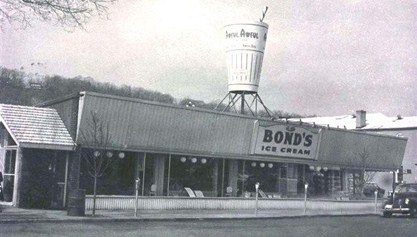
Bond's_Ice_Cream_-_Monticlair_NJ - Copy (2)Bond’s was a northern New Jersey chain of ice cream stores with a couple of traditions appealing to gluttonous teenagers. One was a Pig’s Dinner, featuring several scoops of ice cream slathered with various toppings and served in a dish designed to look like a trough. Anyone finishing the dish was memorialized with a listing on the wall and received a pin to wear reading “I was a pig at Bond’s.” I was certain I’d have no trouble polishing off the dish; I just had no interest in the appellation.

Awful AwfulThe other Bond’s tradition was an Awful Awful, so called because it was “awful big and awful good.” It was a milkshake made with five scoops of ice cream, served with a straw but so thick it really required a spoon. If you could get through four of them, the fifth one was free. A boy at school bet me I couldn’t pass that test and even offered to foot the bill if I wanted to try. I did, but I forgot on the night we’d arranged and ate dinner first – meat loaf, potatoes, vegetable as I recall – and there he was at the door to pick me up. Okay, I thought, I can do this. So off we went to Bond’s. I got through three Awful Awfuls before admitting defeat.

In the sorority house at college, it became common knowledge that I usually wore two half-slips in an effort to fill out the pencil-thin skirts that were the style. Once, someone put an ad in my mail cubby from Frederick’s of Hollywood for a padded girdle designed to give the wearer the appearance of a backside. “Pat, maybe you should try this,” the person had written on the clipping. Years later, at a sorority reunion, I reminded my aging sisters of the incident and offered an opportunity for the guilty party to “fess up, no hard feelings.” But no one stepped forward, and in fact, it appears I was the only one with memory of the incident.

Besides, by that time being too thin had long since stopped being a problem.

On a Clear Day I Can Read a Menu

brooke shields 3

 You know you’ve been around a long time when the Ivory Soap baby needs reading glasses.

In a commercial for Foster Grant eyewear, Brooke Shields notices her dining companion squinting at the menu and hands her glasses across the table. Then she also squints at her own menu and takes them back. Been there, done that.

The actress, and at one time wildly successful fashion model, was through the years repeatedly heralded among “the most beautiful women in the world.” Her first modeling job for Ivory soap came when she was 11 months old. Her most famous one was probably the “nothing comes between me and my Calvins” ads for Calvin Klein jeans when she was 15. (She’s also, I’m sure you know, a Princeton graduate, author, former wife of tennis star Andre Agassi and now apparently more happily married to writer/producer Chris Henchy and the mother of two daughters.)

So about reading glasses. I remember well telling the eye doctor that even with my reading glasses I was experiencing difficulty with printed words on paper, and the doctor, who was a friend, began by saying, “Well, Pat, when we get to a certain age…” I stopped him. “You’re going to say I need bifocals, aren’t you? Well, if that’s the case they’ll have to be the kind with no lines.” This was so long ago that I would be his first patient with the lineless – otherwise known as progressive – lenses so he was most interested in how well I would adapt to them. The answer was just fine, once I made a few trips up and down stairs.

(I’d already begun leaving my old glasses on longer for simplicity sake; at least you always knew where they were. Also, I noticed in business meetings how distracting it was when people continually put on and took off their glasses. “Hmm, now he’s going to put them on. And watch, now he’s going to take them off. Oops, there he goes again, putting them on. And what exactly did he just say? Who knows.”)

That same doctor friend offered me a way to try out bifocal contact lenses when they became available. The idea of sticking something in my eye had never appealed to me but I was intrigued. “How does that work?” I asked. “How do you get the bifocal part in the right place?” Very simple: The bifocal part of the lens is all around the perimeter so no matter how they’re inserted when you look down to read you’re looking through the correct part. Pretty ingenious on someone’s part. Anyway, this doctor would let me take as long as necessary to get used to contacts, working with his nurse/assistant until I was proficient at inserting and removing the lenses. I went for several sessions, and on the final one with my brand new kit all set up and ready for me to take home, we went through one more trial. Suddenly, a speck of eye makeup got in there with the lens, causing pain that I remember as excruciating. “Take it out, take it out!” I screamed. “Now, now,” she said in her calm nurse/assistant voice, “you know how to do it. You take it out.” It took some doing but I got the lens removed and said, “You know, I think I need more practice. I’ll come back.” But I never did.

And now I’m at the age where I’ll one day need cataract surgery, once the silly things are deemed “ready.” But for now, I can read restaurant menus just fine.

Photo: Facebook